AI-First vs. Traditional Universities: Which Path Leads to the Future?
Explore the key differences between AI-first and traditional universities. Understand how an AI-integrated education model prepares students for the future of work.
Category: AI Knowledge
''' AI-first universities integrate artificial intelligence into the core of their educational and operational framework, making it a fundamental design principle. Unlike traditional universities, which typically use AI as a supplementary, add-on tool, AI-first institutions re-imagine curriculum, research, and student support around AI's capabilities to better prepare students for an AI-driven world [source]. This represents a foundational shift from reacting to technology to building education around it.
Key Takeaways
* **Core Difference**: AI-first universities like [Alpha University](/university) are designed *around* AI as a core principle, whereas traditional universities add AI tools *to* their existing, centuries-old structures. * **Future Outlook**: Experts project that AI-first universities will significantly outperform their traditional counterparts in student success and workforce alignment by 2040 [source]. * **Student Impact**: The AI-first model focuses on developing AI fluency, critical thinking, and ethical reasoning, preparing the [Alpha Generation](/alpha-generation) for jobs that don't even exist yet. * **Beyond the Hype**: True AI-first adoption is about deep, strategic integration into the institutional framework—not just giving students access to [AI tools](/ai-tools). * **The Human Element**: In an AI-first model, the role of the educator becomes more critical, evolving from a lecturer to a mentor who guides students in critical assessment and real-world application.
***
The landscape of higher education is undergoing a quiet, yet seismic transformation [source]. The rise of powerful artificial intelligence is forcing every institution, student, and parent to ask a fundamental question: Is the traditional university model built to last? Or is a new model—the "AI-first university"—the only path forward?
This article breaks down the definitive differences between these two models to help you understand this new educational paradigm.
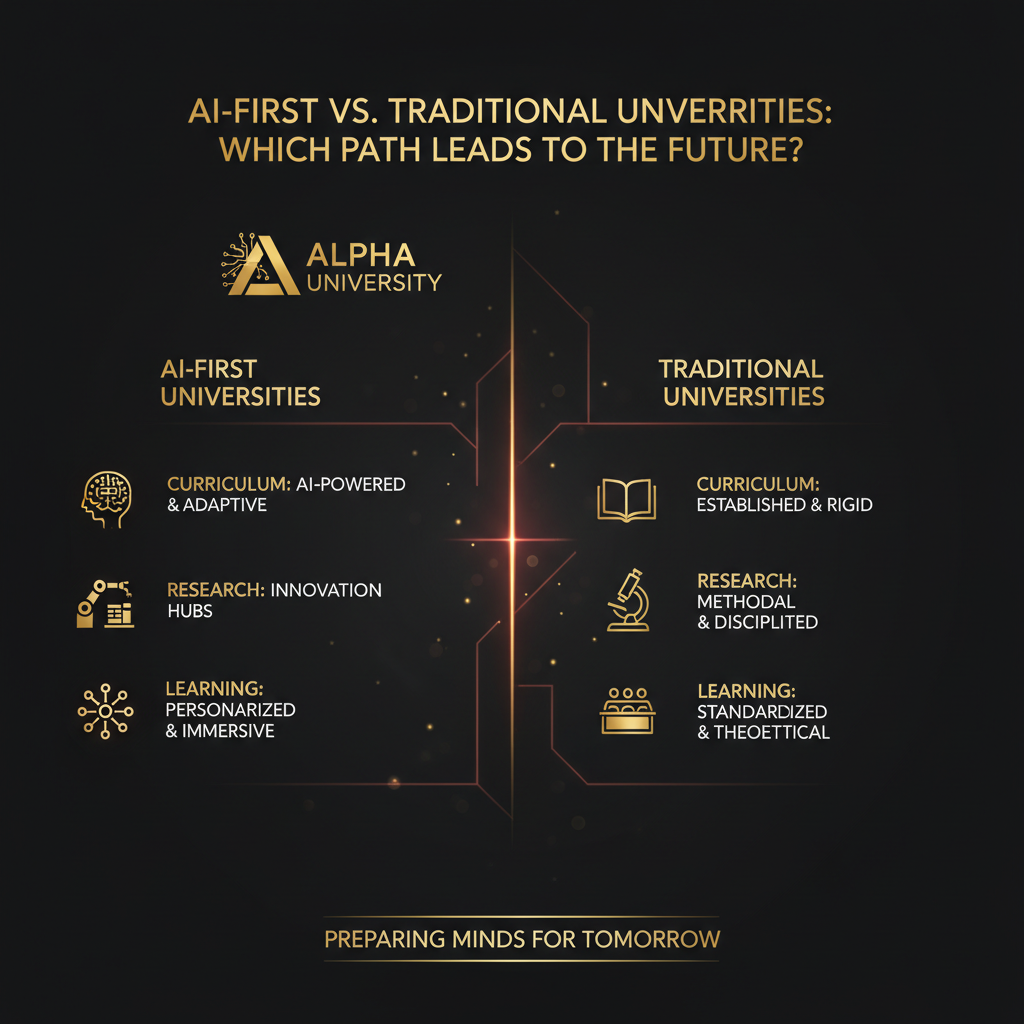
What is a Traditional University?
A traditional university operates on a model that has been refined over centuries. Its core structure is built on lectures, physical libraries, siloed academic departments, and in-person examinations. Technology, including AI, is often adopted in a "reactive," policy-memo-driven way [source]. It's treated as an external tool to be managed, regulated, or bolted onto existing courses and administrative processes.
While many traditional institutions offer excellent programs, their foundational design predates the AI revolution. Integrating AI is often a slow, department-by-department process, limiting its transformative potential [source].
What is an AI-First University?
An AI-first university, in stark contrast, is built with AI as a core design principle from the ground up. It assumes AI is a ubiquitous, foundational element of modern life and work. Rather than asking, "How can we use this AI tool?" it asks, "How do we redesign our entire educational experience now that AI exists?"
This involves a complete reimagining of: * **Curriculum**: Courses are designed to teach students how to think, create, and problem-solve *with* AI as a partner. * **Operations**: AI is leveraged to create hyper-personalized student support, streamline enrollment, and improve retention [source]. * **Pedagogy**: The role of the professor shifts from "sage on the stage" to "guide on the side," mentoring students in a world of information abundance.
Leading institutions are beginning to create this AI-first template, but Alpha University is pioneering it to specifically prepare the [Alpha Generation](/alpha-generation) for a world where AI is not just a tool, but a collaborator.
The Core Showdown: AI-First vs. Traditional Universities
The difference isn't just about using technology; it's about core philosophy. While a traditional university might have a policy on using ChatGPT, an [AI University](/ai-university) builds entire courses around leveraging Large Language Models for advanced research and creativity.
Here’s a direct comparison:
| Feature | Traditional University | AI-First University (like Alpha) | |---|---|---| | **Core Philosophy** | AI is a tool to be managed and added to existing structures. | AI is a foundational principle around which the university is designed. | | **Curriculum Design** | Static, lecture-based. AI is an optional, often restricted, supplement. | Dynamic, project-based. Teaches AI fluency and collaboration in every subject. | | **Role of Educators** | Lecturer and subject matter expert who delivers information. | Mentor and coach who guides critical thinking and application of AI insights. | | **Student Skills** | Focus on knowledge retention and traditional research methods. | Focus on critical thinking, ethical AI use, adaptability, and human-AI collaboration. | | **Tech Adoption** | Reactive and incremental; often siloed within specific departments. | Proactive and holistic; integrated across all operations and academics. | | **Career Preparation** | Prepares students for the current job market. | Prepares students for the future of work by building durable, AI-proof skills. |
Why the 'AI-First' Distinction is a Game-Changer
Simply put, the future of work demands a different kind of graduate. The World Economic Forum has consistently reported that critical thinking, creativity, and analytical skills are paramount. An AI-first education is explicitly designed to cultivate these abilities.
Experts predict that the gap between the two models will widen dramatically, with AI-first institutions outperforming traditional ones on key metrics like financial planning, workforce alignment, and student success by 2040 [source].
This isn't a "meaningful advance"; it's the beginning of a genuine paradigm shift in education [source]. Sticking with a pre-AI model is like learning to navigate by the stars when everyone else has GPS. It’s a noble skill, but it’s no longer the most effective way to get where you need to go.
At Alpha University, we see this as our core mission: to provide the map and the GPS for the coming era. To not just [learn AI](/learn-ai), but to learn *with* it.
The Role of the Student in an AI-Powered World
One of the most vital shifts in an AI-first model is the role of the student. In a traditional system, the student is often a passive recipient of information. Success is measured by the ability to recall that information.
In an AI-first university, the dynamic flips. AI can generate information instantly. The student's job is not to absorb it, but to question it, validate it, synthesize it, and transform it into something new. As one expert notes, AI can deliver content, but it cannot transform the learner [source]. True learning—the kind that leads to personal and intellectual growth—requires active engagement.
The AI-first student is an active driver of their education. They are collaborators, critical thinkers, and ethical leaders who understand that AI’s output is a starting point, not a final answer.
Common Misconceptions About AI in Higher Education
As with any major technological shift, a great deal of misinformation surrounds AI's role in universities.
**Misconception 1: "Using AI tools makes you an AI-first university."** This is the most common error. True AI-first strategy is not about providing access to software. It's a deep, structural commitment to integrating AI into the institutional DNA, from admissions and career services to the core curriculum [source].
**Misconception 2: "AI will make universities and degrees obsolete."** Evidence suggests the opposite may be true. In an era of AI-generated content and potential cheating, a verified credential from a reputable institution that upholds rigorous academic standards may become *more* valuable, not less [source]. The key is that the institution must adapt to verify skills in a new way.
**Misconception 3: "AI handles the thinking for you."** This is a dangerous assumption. AI is a powerful information-processing tool, but it doesn’t possess consciousness, wisdom, or critical judgment. The most valuable skills in the AI era are predicated on a human’s ability to direct the AI, assess its output, and apply ethical considerations. An AI-first curriculum elevates these human skills.
Is an AI-First University Right for You?
Choosing a university is a life-altering decision. The right choice depends on your goals, learning style, and vision for your future.
**A traditional university might be a fit if:** * You thrive in a highly structured, lecture-based environment. * Your chosen field is less susceptible to immediate AI disruption. * You prefer established, centuries-old institutional brands.
**An AI-first university like Alpha University is likely your best path if:** * You want to be prepared not just for a job, but for a career that will evolve with technology. * You are a curious, proactive learner who wants to be a collaborator in your education. * You believe that learning to harness AI is a fundamental skill for the 21st century, no matter your field. * You want to join a community that is actively building the future of education, not just reacting to it.
The Alpha University Edge: Built for the Alpha Generation
At [Alpha University](/ai-university), we didn’t add AI to the old model. We built a new model for a new generation. We are the world's first university designed from the ground up to prepare the [Alpha Generation](/alpha-generation) for leadership in an AI-first world.
Our entire approach is built on the conviction that your education should be as dynamic, innovative, and intelligent as the world you’re about to enter. We equip you with the technical skills, the ethical framework, and the critical thinking ability to thrive in an age of automation.
*** Written by the curriculum designers and AI integration specialists at Alpha University, the leaders in AI-first education.