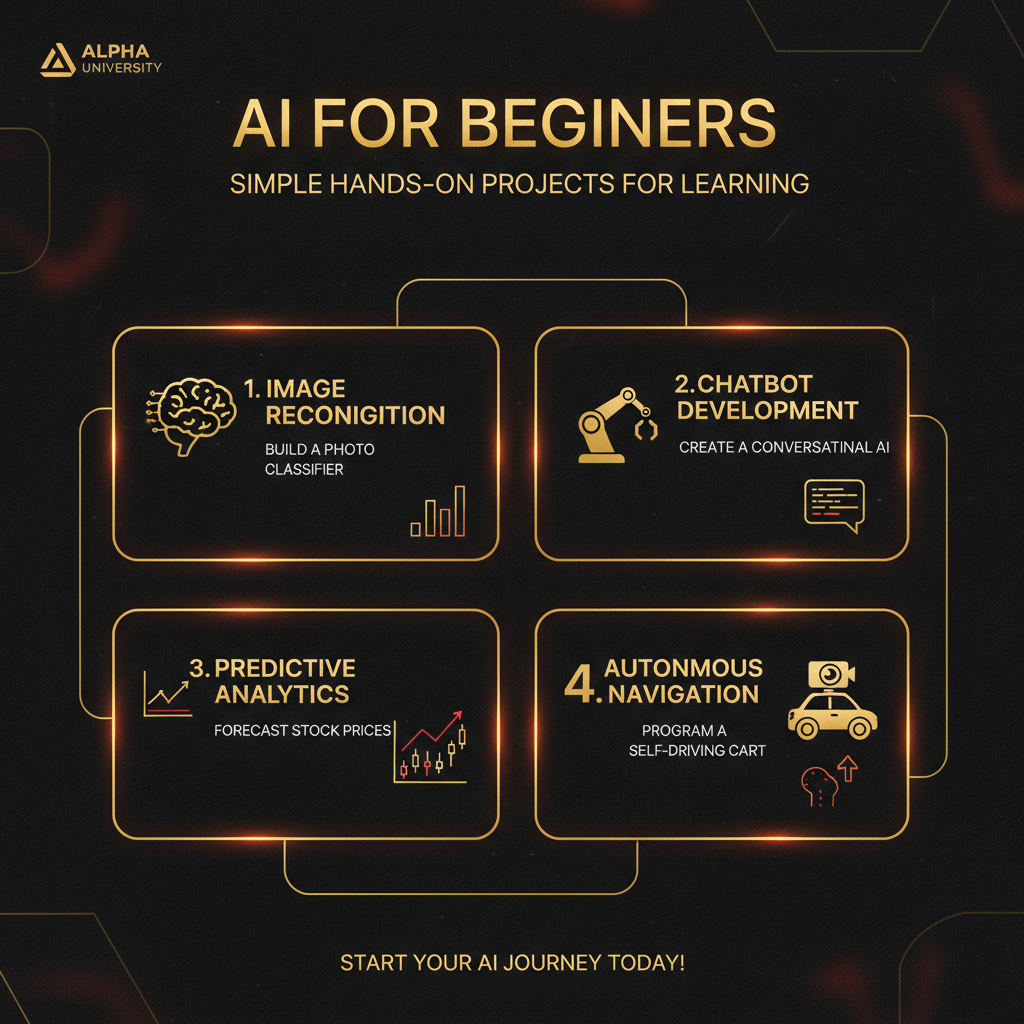
AI for Beginners: Simple Hands-On Projects for Learning
Don't just learn AI theory. Build it. Explore our definitive guide to hands-on AI projects for beginners, from spam filters to sentiment analysis, and start building your portfolio today.
Category: AI Knowledge
Getting started with AI requires moving from theory to practice. The best way for beginners to do this is by building hands-on projects like a spam email blocker, a sentiment analysis tool, or a handwritten digit recognizer, which solidify core concepts and build a strong portfolio.
Key Takeaways
* Hands-on projects are the most effective way for beginners to truly understand and apply AI concepts. * You don’t need to be an expert programmer; many impactful projects can be built with basic skills and no-code tools. * Beginner-friendly projects include spam filters, sentiment analysis, chatbots, and price predictors. * Building a portfolio of AI projects is essential for enhancing your resume and standing out in the tech industry.
Why Reading About AI Isn’t Enough
Reading articles and watching tutorials is a great first step, but to truly [Learn AI](/learn-ai), you have to get your hands dirty. Engaging in hands-on projects is crucial for beginners to grasp Artificial Intelligence (AI) concepts and build a strong foundation [source]. The act of building bridges the gap between theoretical understanding and real-world implementation, turning abstract ideas into tangible skills [source].
These projects offer practical experience, enhance your resume, and can help you stand out in the competitive tech industry [source]. They are proof that you can not only talk the talk but walk the walk.
Mythbusting: AI Projects Are Not Just for Experts
A common misconception is that building AI projects is only for PhDs and advanced programmers. This is no longer true. While complex research requires deep expertise, the AI field has become increasingly accessible. The availability of user-friendly [AI Tools](/ai-tools) and well-defined beginner projects proves that practical AI experience is attainable for anyone with foundational knowledge [source].
Another myth is that extensive coding is always required. With the rise of no-code and low-code platforms, even beginners can create powerful AI-powered applications without writing a single line of code, saving time while still providing an invaluable hands-on learning experience [source].
10 Simple AI Projects for Your Portfolio
Experts agree that after you master the basics of our [AI for Beginners](/ai-for-beginners) guide, it's time to start building. Here are ten highly recommended projects that are perfect for starting your journey.
1. **Spam Email Blocker:** A classic project. You can train a model to distinguish between legitimate emails and spam, filtering unwanted messages from an inbox [source]. 2. **Sentiment Analysis Tool:** Analyze text data, like product reviews or social media comments, to determine if the sentiment is positive, negative, or neutral. This is a cornerstone of modern marketing and customer service analytics [source]. 3. **Handwritten Digit Recognition:** This is a famous machine learning project where you train a neural network to identify handwritten numbers from the MNIST dataset [source]. 4. **Customer Service Chatbot:** Automate responses to common customer questions. You can start with a simple rule-based chatbot and progressively make it smarter using machine learning and natural language processing (NLP) [source]. 5. **Stock Price Prediction:** While you shouldn't bet your life savings on it, using historical data to predict future stock movements is a fantastic way to learn about time-series analysis and regression models [source]. 6. **House Price Prediction:** Similar to stock prediction, this project uses features like square footage, number of bedrooms, and location to predict real estate values [source]. 7. **Face Detection System:** Train a model to identify and locate human faces in images or video streams. It's a great introduction to the world of computer vision [source]. 8. **Language Translation Tool:** Build a simple application that can automatically translate text from one language to another using pre-trained AI models [source]. 9. **Breast Cancer Classification:** A common and impactful machine learning project that involves classifying medical data, in this case, determining if a tumor is benign or malignant [source]. 10. **Generative AI Text Creator:** With the rise of Large Language Models (LLMs), you can now build simple tools that generate human-like text, create summaries, or even write code snippets based on a prompt [source].
Getting Started: Your First AI Project in 5 Steps
1. **Pick Your Project:** Choose one from the list above that genuinely interests you. Passion is a powerful motivator. 2. **Define the Problem:** Clearly state what you want your AI to do. For a sentiment analysis tool, the problem is: "Given a sentence, classify it as positive, negative, or neutral." 3. **Gather Your Data:** AI is data-driven. You'll need a dataset to train your model. For sentiment analysis, you can find many free datasets of customer reviews. 4. **Choose Your Tools:** Will you code it from scratch using Python libraries like Scikit-learn and TensorFlow? Or will you use a no-code platform to get started faster? There is no wrong answer. 5. **Build, Train, and Test:** This is the fun part. Build your model, train it on your data, and test its performance. Then, iterate. Refine your model, try different approaches, and see how you can improve its accuracy.
Completing these projects demonstrates initiative and capability, traits that define the [Alpha Generation](/alpha-generation) of builders and creators.
Ready to Build More Than Just Projects?
Building beginner projects is the first step. The next is to build a career. If you’re serious about mastering the skills that will define the next century and want a structured path from fundamentals to expert, then you are ready for Alpha University.
We provide the curriculum, the community, and the expert guidance to move beyond simple projects and tackle complex, real-world challenges. At [AI University](/ai-university), we don’t just teach you about AI; we empower you to build the future with it.