The Ultimate AI Learning Path for Kids (Alpha Generation Guide)
Discover the definitive AI learning path for kids. This guide helps parents and young learners of the Alpha Generation understand, use, and create with AI.
Category: AI Knowledge
An AI learning path for kids is a structured educational journey designed to teach children about artificial intelligence in an age-appropriate way. It focuses on three core pillars: understanding the concepts behind AI, using AI tools safely and effectively, and learning to create simple AI applications. The goal is to build foundational AI literacy for the [Alpha Generation](/alpha-generation), preparing them for a future where AI is ubiquitous.
Key Takeaways * AI literacy is a fundamental skill for the Alpha Generation, as AI is already integrated into daily life. * A complete AI education for kids is built on three pillars: Understanding (the concepts), Using (the tools), and Creating (the applications). * The learning path can be adapted by age, starting with play-based exploration and moving towards hands-on coding and critical thinking. * A common misconception is that learning AI is only for older kids or requires advanced coding; foundational concepts can be taught at a young age without prior experience [source].
***
Why an AI Learning Path for Kids Matters
For parents of the **[Alpha Generation](/alpha-generation)**, the conversation around screen time is rapidly evolving into a conversation about AI. It’s no longer a far-off concept from science fiction; AI is already here, embedded in the tools and toys our children use every day. It’s in the YouTube recommendation engine, the voice of Alexa or Siri, and the magical filters on social media apps [source].
Providing children with a deliberate learning path for artificial intelligence isn’t about turning them all into coders or data scientists. It’s about teaching them a fundamental literacy for the 21st century. Just as we teach them to read the written word, we must teach them to "read" the AI-driven world.
Understanding AI helps children become thoughtful creators and informed digital citizens, equipping them to navigate the challenges and opportunities of an automated world with confidence [source]. It moves them from being passive consumers of technology to active participants who understand the systems shaping their lives.
The Three Pillars of AI Education for Kids
Experts agree that a holistic AI education should be built on three foundational pillars [source]. This framework ensures children develop a comprehensive understanding, moving from theory to practical, and finally to creative application.
Pillar 1: Understanding How AI Works
Before a child can use or create with AI, they need a basic grasp of what it is. This doesn’t require diving into complex algorithms. Instead, it’s about demystifying the "magic."
Here, the focus is on core concepts: * **How does a machine "learn"?** Use simple analogies, like teaching a pet a new trick through repetition and rewards. * **How does a computer "see"?** Explain image recognition by showing how an AI is trained on thousands of pictures of cats to learn what a cat looks like. * **How does a phone "understand" your voice?** Talk about how voice assistants are trained on language patterns to respond to commands.
Resources like the MIT Media Lab's AI Education website provide excellent, non-technical materials designed specifically for this purpose [source]. The goal is to build a mental model, replacing mystery with curiosity and foundational knowledge.
Pillar 2: Using AI Tools Effectively and Safely
With the explosion of generative **[AI Tools](/ai-tools)** like ChatGPT and DALL-E, this pillar has become critically important. Children are already using these tools, whether for homework help or creating fun images. The learning path here is about responsible and effective usage.
Key lessons include: * **Prompting as a Skill:** Teaching kids how to ask clear, specific questions to get better results from an AI. * **AI as a Creative Partner:** Encouraging them to use AI for brainstorming story ideas, generating art concepts, or debugging simple code. * **Digital Citizenship & Ethics:** Discussing the limitations of AI, such as "hallucinations" (making things up) and bias. This is the time to instill a healthy skepticism and the habit of fact-checking AI-generated information.
Learning to use AI is like learning to use a search engine—it's a skill that enhances learning across all other subjects [source].
Pillar 3: Creating with AI
This is where learning becomes tangible and exciting. In this phase, kids move from understanding and using AI to building with it. This doesn’t mean they need to build the next ChatGPT. It means starting with small, achievable projects that incorporate AI features.
Platforms like Create & Learn and Code.org offer curricula for kids as young as 4th grade to start coding AI projects [source, source].
Examples include: * **Block-Based Coding:** Using platforms like Scratch to create games that use a simple machine learning model (e.g., a game that responds to spoken commands). * **Simple Python Projects:** For older kids, this could involve writing a few lines of code to connect to an AI API to build a simple chatbot or image classifier.
The act of creating solidifies understanding like nothing else. It empowers children and shows them that AI is not just something that happens *to* them; it's something they can control and create with.
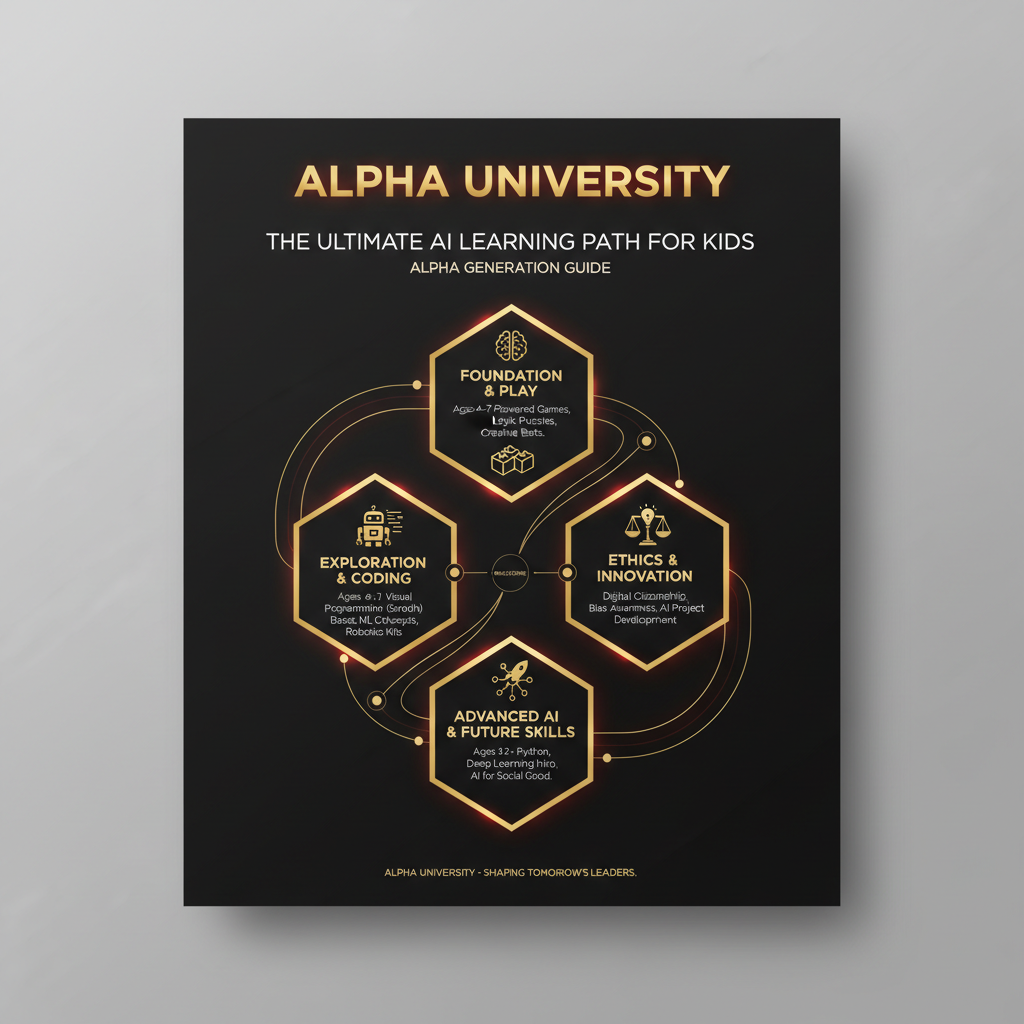
A Sample AI Learning Path (By Age Group)
An effective learning path meets children where they are. Here is a sample breakdown of how to introduce AI concepts at different stages of development.
Ages 5-7: Curiosity & Play
At this age, the focus should be 100% on "unplugged" activities and playful discovery. The goal is to build familiarity and curiosity, not technical skill.
* **Activities:** Play "I Spy" and talk about how a computer would need to learn all the different objects. Sort objects by color, shape, and size, explaining that this is how machines "classify" data. * **Tools:** Use simple AI-powered toys or apps that give immediate feedback, demonstrating cause and effect.
Ages 8-12: Exploration & Foundational Skills
This is the sweet spot for introducing foundational concepts and block-based coding. Kids in this age group can grasp abstract ideas and have the patience for guided projects.
* **Activities:** Introduce visual coding platforms like Scratch or MakeCode to build simple games. Begin guided use of generative AI for school projects, with a heavy emphasis on fact-checking. * **Tools & Platforms:** Explore structured curriculums like those offered by Little LIT AI, which provide K-12 AI-powered learning and personalized tutors [source]. This is the perfect age to **[Learn AI](/learn-ai)** concepts in a more formal but still fun way.
Ages 13+: Application & Creation
Teens are ready for more complex challenges and real-world applications. They can handle text-based programming languages and begin to think critically about the societal impact of AI.
* **Activities:** Transition from block-based coding to Python, the primary language for AI development. Work on projects that use real AI APIs. Engage in debates about AI ethics, bias in algorithms, and the future of work. * **Tools & Platforms:** High school programs like those from Code.org are designed to blend real-world AI applications with computer science fundamentals, requiring no prior experience [source]. This is also the stage where a comprehensive program like **[AI University](/ai-university)** becomes invaluable.
Common Misconceptions About Kids Learning AI
As with any emerging field, several myths surround AI education for kids. Let's clear a few up.
**Myth 1: AI is too new and complex for kids.** The truth is, AI has been shaping our world for years, long before tools like ChatGPT became household names [source]. The basics can be taught through simple anologies and play, making it accessible even to young children.
**Myth 2: Learning AI is all about advanced coding.** This is a significant misconception. As our three-pillar model shows, coding is only one part of the journey. Foundational knowledge about how AI works and how to use existing tools responsibly are equally, if not more, important [source, source].
How Alpha University Prepares the Next Generation
Understanding this learning path is the first step. The next is finding a partner to help you navigate it.
At Alpha University, we are built from the ground up to prepare the **[Alpha Generation](/alpha-generation)** for an AI-first world. Our curriculum is designed around the three pillars of understanding, using, and creating. We believe in moving beyond rote memorization to foster critical thinking, creativity, and ethical leadership.
Our programs translate the complex world of AI into engaging, hands-on projects that are perfectly suited for young learners. We provide a clear roadmap for parents and a vibrant community for students. If you're ready to give your child the tools to thrive in the future, we invite you to join **[AI University](/ai-university)**.