Future-Proof Your Child: Essential AI Skills for Tomorrow's Jobs
Discover the essential AI literacy skills your child needs for future career success. Learn why AI knowledge is critical for tomorrow's jobs and how to prepare.
Category: AI Knowledge
AI literacy is the ability to understand, use, and critically evaluate artificial intelligence. For the coming generation of students and young professionals, these skills are no longer optional but foundational for future career success, as AI integration becomes the standard across all industries.
Key Takeaways
* **The #1 Skill:** AI literacy is the top skill employers are seeking in 2025, yet most job seekers don't list it [source]. * **The New Foundational Skill:** It's becoming as fundamental as digital literacy was a decade ago, essential for navigating the modern workplace [source]. * **Career Growth:** AI is expected to create new roles, and workers with [AI Skills](/ai-skills) can expect higher salaries and better long-term growth [source]. * **The Education Gap:** A major gap exists between industry needs and the current education system, with only 3% of employers believing graduates are prepared for an AI-driven future [source]. * **Beyond Coding:** Being AI-literate is not about becoming a programmer; it's about using AI tools effectively, understanding their outputs, and recognizing their limitations.
---
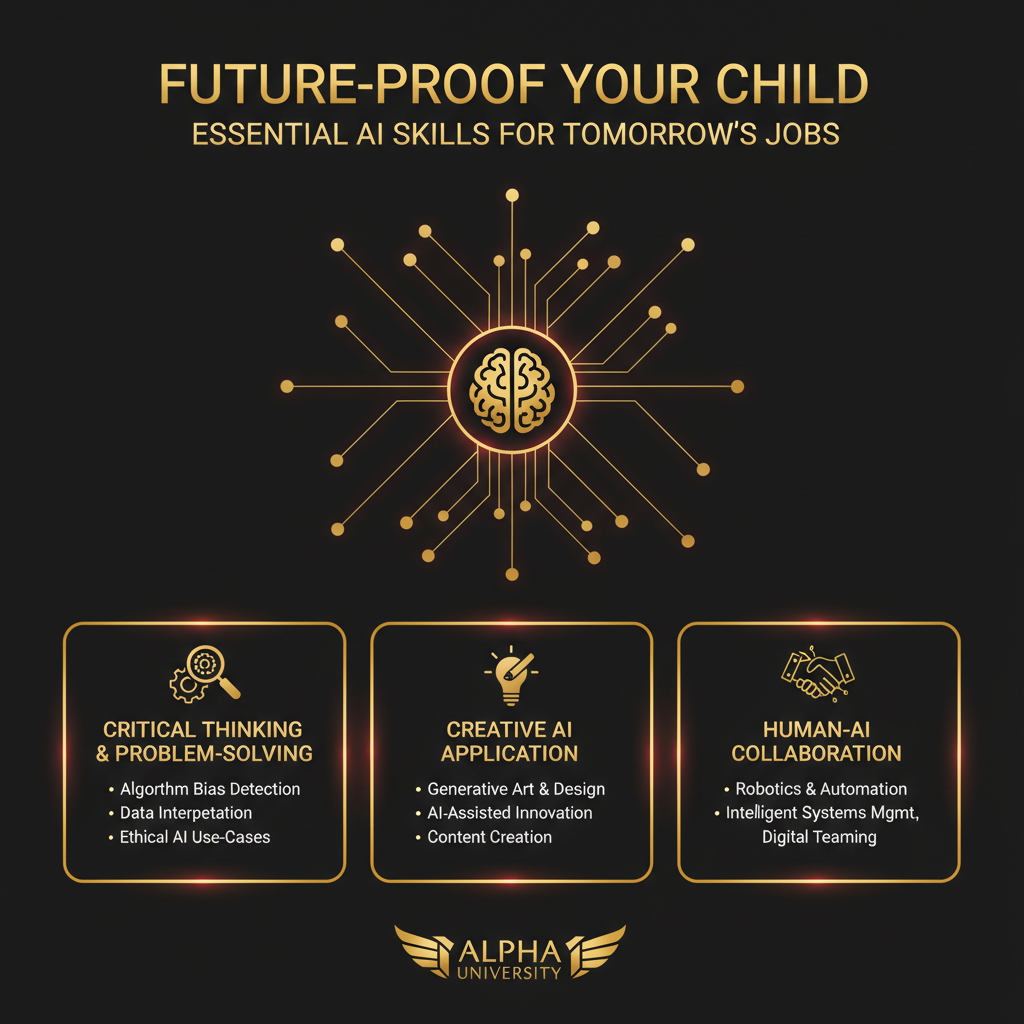
What is AI Literacy, Really?
AI literacy isn't about being able to build an AI from scratch. It’s the ability to **understand** what AI is, **use** it effectively in day-to-day tasks, and **critically evaluate** its outputs and impact. Think of it less like learning to be a mechanic and more like learning to drive a car—you need to know the rules of the road, how to operate the vehicle safely, and what to do when something goes wrong.
Experts now consider it an essential skill for every professional, as crucial as digital literacy has become for career success [source]. From business decisions to team collaboration, the ability to leverage AI is becoming a baseline expectation in the workplace [source]. It’s about working *with* AI as a partner to improve efficiency, solve complex problems, and generate new ideas.
Why AI Literacy Is the New "Digital Literacy" for the Alpha Generation
For parents thinking about their child's future, this is a critical moment. Just as we taught previous generations how to use computers and the internet, we must now equip the [Alpha Generation](/alpha-generation) with AI literacy. The world they will enter for work won't just have AI as an option; it will be deeply integrated into nearly every role and industry.
According to Forbes, AI literacy has become the number one skill employers are looking for in 2025, surprising even seasoned career counselors [source]. While 72% of employers believe AI will lead to some job reductions, 62% also expect it to create entirely new roles [source]. The individuals who can fill these roles—and thrive in existing ones—will be those who are AI-literate. The demand is surging, with 85% of companies planning to upskill their workforce in AI and prioritizing it in new hires [source].
The 5 Core AI Literacy Skills for Future Careers
So, what does it mean to be "AI-literate"? It breaks down into five core competencies that every future professional should develop.
1. Understanding Fundamental AI Concepts This doesn't require advanced math or computer science. It's about grasping the "what" and "why" behind AI. A literate individual understands the basic difference between narrow AI (like a language translation app) and general AI, and has a conceptual handle on terms like "machine learning," "neural networks," and "large language models" (LLMs). This foundational knowledge helps demystify AI and provides context for how these systems work.
2. Skillful Use of AI Tools (Prompt Engineering) This is perhaps the most practical and immediate skill. It involves knowing how to communicate with AI to get the desired results—a practice often called "prompt engineering." This means crafting clear, concise instructions and questions for [AI Tools](/ai-tools) like ChatGPT, Gemini, or Midjourney. It also involves learning how to refine prompts to improve outputs, turning the AI from a simple calculator into a powerful brainstorming partner and productivity engine.
3. Critically Evaluating AI Output AI makes mistakes. It can "hallucinate" facts, reflect biases from its training data, and produce information that is outdated or simply incorrect. A core tenet of AI literacy is approaching AI-generated content with a healthy dose of skepticism. This means fact-checking its claims, questioning its conclusions, and understanding that its output is a starting point for human refinement, not a finished product.
4. Understanding AI Ethics and Limitations An AI-literate person thinks about the broader implications of the technology. They consider questions of data privacy, algorithmic bias, and the societal impact of automation. They understand that AI is not a neutral technology; it is shaped by its creators and the data it’s trained on. This ethical awareness is crucial for responsible innovation and for building trust in AI systems.
5. AI-Assisted Problem Solving and Collaboration Ultimately, the goal of AI in the workplace is to augment human capability. AI literacy means knowing how to integrate AI into your workflow to solve problems more effectively. This could involve using AI to analyze a large dataset to spot trends, generating creative campaign ideas for a marketing class project, or summarizing complex research to speed up learning. It’s about viewing AI as a "cognitive collaborator" that helps you think better and faster.
AI in an Industry Near You: How Jobs Are Changing Today
The demand for AI literacy isn't some far-off future prediction; it’s happening now across every field.
* **Healthcare:** AI is helping doctors diagnose diseases earlier and personalize treatment plans. AI-literate medical professionals will be better equipped to use these tools to improve patient outcomes. * **Finance:** Algorithms now manage investment portfolios and detect fraudulent transactions. Financial analysts who understand AI can leverage it to make smarter, data-driven decisions. * **Marketing:** From writing ad copy with tools like Jasper to analyzing customer behavior, AI is transforming how brands connect with audiences. Marketers who are not using AI are already falling behind. * **Creative Arts & Design:** AI tools are co-creating music, designing graphics, and even writing scripts. Artists and designers are using AI as a new medium for expression. * **Social Work & Education:** Even in human-centric fields, AI is being used to identify at-risk students or to provide personalized learning paths [source].
In each of these industries, a golden opportunity is emerging for those who can lead AI initiatives and help their organizations navigate this new landscape [source]. To get started on this path, you first have to [Learn AI](/learn-ai) fundamentals.
The Critical Education Gap: Why Today's Schools Aren't Preparing Students
Despite the clear and urgent demand from the workforce, our education system is lagging dangerously behind. A staggering **97% of employers** feel that higher education is not adequately preparing students for an AI-driven future [source].
This creates a massive disconnect. Parents and students believe school is preparing them for the job market, while employers know it isn't. The curriculum is often years behind the technology, and many educators lack the training to teach AI literacy effectively. This leaves a generation of students at risk of graduating with an obsolete skill set, unprepared for the realities of the modern workplace.
How to Build Essential AI Literacy Skills Today
For parents and students looking to bridge this gap, waiting for schools to catch up is not an option. Building AI literacy requires a proactive, hands-on approach.
1. **Start with the Fundamentals:** Begin by exploring resources that explain the basics of AI in simple, accessible terms. Watch documentaries, read articles, and get familiar with the vocabulary. 2. **Get Hands-On:** The best way to learn is by doing. Experiment with free AI tools like ChatGPT, Google's Gemini, or Microsoft Copilot. Try to use them for homework help, brainstorming ideas, or just for fun. See what works and what doesn't. 3. **Follow the Experts:** Follow AI researchers, ethicists, and journalists on social media or in the news to stay current on the latest developments. 4. **Take a Structured Course:** Self-exploration is great, but a structured learning environment can accelerate progress exponentially. This is where a dedicated program can make all the difference.
Alpha University: Your Partner in AI Education
Recognizing the critical gap left by traditional education, [AI University](/ai-university) was founded to equip the next generation with the essential skills for an AI-powered future. We provide a structured, comprehensive, and hands-on learning roadmap designed specifically for students.
At Alpha University, we move beyond theory. Our curriculum is built on practical application, ethical considerations, and real-world problem-solving. We empower students to become not just users of AI, but leaders who can shape its future responsibly. We believe that AI literacy is the key to unlocking the potential of the [Alpha Generation](/alpha-generation) and ensuring they are not just ready for future careers, but are prepared to define them.