Building an AI Curriculum: Alpha University's Approach
A definitive guide for administrators on AI education curriculum development. Learn to create, implement, and scale effective AI learning programs with Alpha University's framework.
Category: AI Knowledge
Developing an AI education curriculum involves defining clear learning objectives, covering foundational concepts, practical skills, and ethical considerations. The process requires integrating hands-on projects, providing robust teacher training, and using an iterative approach to keep content current with the rapidly evolving field of artificial intelligence.
Key Takeaways - AI curriculum is essential for preparing students for a future driven by artificial intelligence. - Effective curricula balance foundational theory, practical tool proficiency, and deep ethical understanding. - AI itself can be a powerful tool for instructional designers, helping to personalize learning and automate content creation. - The primary goal is not to replace human educators but to augment their capabilities, freeing them to focus on high-impact teaching. - Successful implementation requires a commitment to ongoing teacher training and a curriculum that evolves with AI technology.
---
Why AI Education is an Imperative
Artificial intelligence is no longer a far-off concept; it is a present-day reality transforming industries, economies, and daily life. For education leaders, the question is no longer *if* we should teach AI, but *how* and *how quickly*. Integrating AI into curriculum design is fundamentally shifting how we approach teaching and learning [source]. The goal is to prepare the **Alpha Generation** to be not just consumers of AI technology, but creators and critical thinkers who can navigate its complexities.
Schools and universities that fail to establish a robust AI education curriculum risk leaving their students unprepared for the future of work and civic life. The demand is for a new kind of literacy—AI literacy—that empowers students to understand and shape the world around them.
What is AI Education Curriculum Development?
AI education curriculum development is the structured process of designing instructional content and learning experiences focused on the principles, applications, and implications of artificial intelligence. It goes beyond simply using **AI Tools** in the classroom. It involves creating a comprehensive program that teaches students *about* AI, including its technical foundations, practical uses, and profound ethical dimensions.
An effective AI curriculum equips learners with the knowledge to understand how AI systems work, the skills to use them effectively, and the wisdom to apply them responsibly.
The Core Components of an Effective AI Curriculum
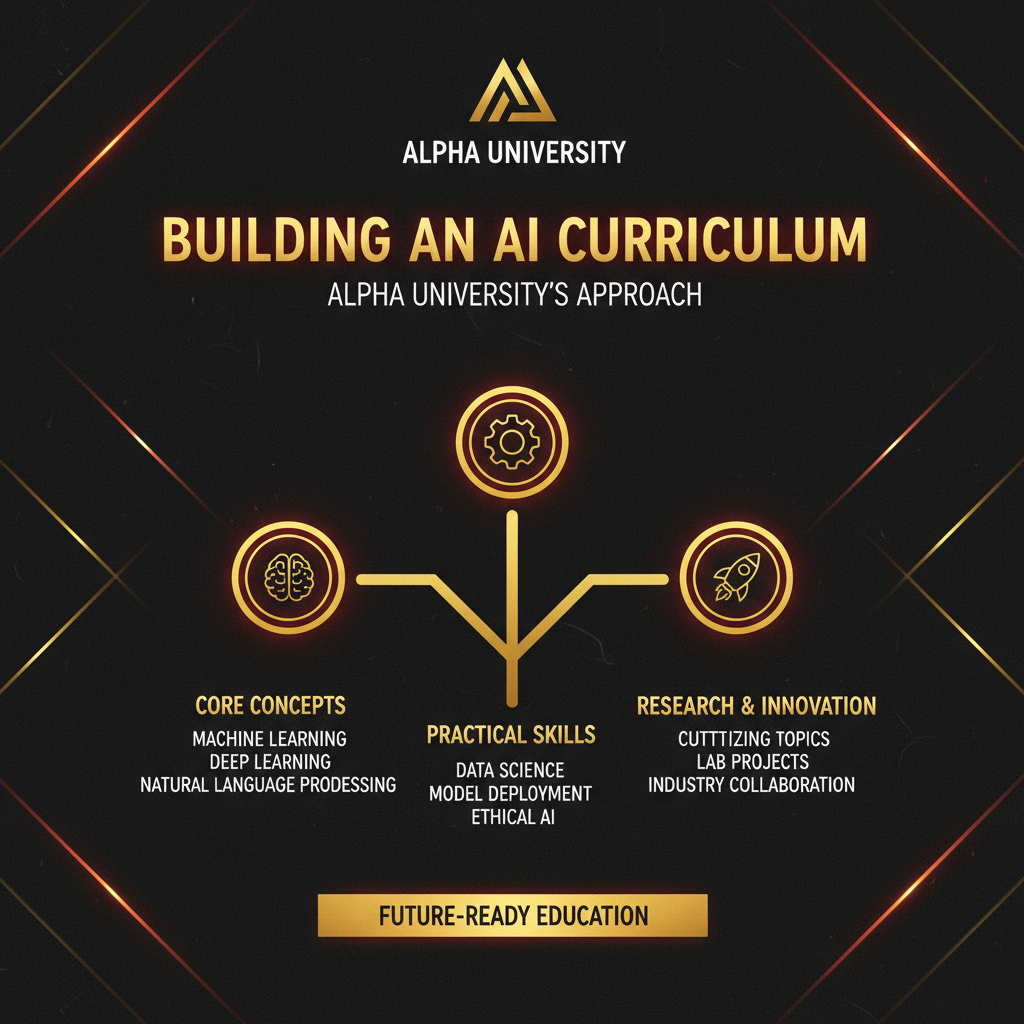
A successful AI curriculum is not monolithic. It must be a balanced, multi-faceted program that caters to diverse learning needs. At Alpha University, we see three essential pillars.
H3: Foundational Concepts (The "What") Before students can build or critique AI, they must understand its core principles. A strong curriculum demystifies the technology with clear definitions and concepts, including: - **Machine Learning & Deep Learning:** The engines of modern AI. - **Neural Networks:** The structure and function of AI "brains." - **Data Literacy:** Understanding the role of data in training AI models. - **Natural Language Processing (NLP):** How AI understands and generates human language.
H3: Practical Skills & AI Tools (The "How") Theory must be paired with practice. Students need hands-on experience to solidify their understanding and build tangible skills. This involves moving from passive learning to active creation. Curriculum should include project-based modules where students can: - **Use and evaluate various AI Tools** for creative and analytical tasks [source]. - **Engage with simple coding exercises** to understand algorithmic thinking. - **Build or train simple models** to see the direct impact of data and parameters.
H3: Ethical Considerations (The "Why") Perhaps the most critical component, ethical considerations, ensure students become responsible architects of the future. This part of the curriculum addresses the complex societal questions AI raises: - **Algorithmic Bias:** How AI systems can perpetuate and amplify human biases. - **Privacy and Surveillance:** The implications of data-centric technologies. - **Job Displacement and Economic Impact:** Preparing for a changing workforce. - **Accountability and Transparency:** Who is responsible when an AI makes a mistake?
A Step-by-Step Guide to Developing Your AI Curriculum
Creating an AI curriculum from scratch can feel daunting. Here is a structured framework for school administrators and curriculum developers.
**Step 1: Define Learning Objectives & Scope** Start with the end in mind. What should students be able to *do* after completing the curriculum? Your objectives should be specific, measurable, and appropriate for the age group. Are you designing a semester-long elective for high schoolers, an introductory module for middle school, or a full degree program for a university?
**Step 2: Map the Curriculum to Student Outcomes** Connect every concept, project, and assessment back to your defined learning objectives. For example, an objective like "Students will be able to identify bias in a facial recognition model" could be met with a lesson on data diversity followed by a project where they test a pre-built model with various images.
**Step 3: Integrate Hands-On Projects and AI Tools** Students **Learn AI** best by doing. Move beyond worksheets and lectures by centering the curriculum on project-based learning. Have students use real-world **AI Tools** to solve problems, create art, or analyze data [source]. This not only builds technical skills but also fosters creativity and critical thinking.
**Step 4: Incorporate Ethical Frameworks and Responsible AI** Embed ethics into every unit, not just as a standalone final chapter. When teaching about data, discuss privacy. When building a model, discuss bias. This holistic approach ensures students see ethics not as a constraint, but as a core component of good design.
**Step 5: Plan for Teacher Training and Support** Your curriculum is only as effective as the educators teaching it. Many teachers are still learning about AI themselves. A successful rollout must include a comprehensive professional development plan that equips them with the confidence, content knowledge, and pedagogical strategies to teach AI effectively.
**Step 6: Assess, Iterate, and Evolve** The field of AI changes in months, not decades. Your curriculum cannot be static. Implement a feedback loop where educators can share what’s working and what isn’t. Plan to review and update the curriculum annually to incorporate new tools, research, and ethical debates.
The Role of AI in Designing Your Curriculum
Beyond teaching *about* AI, the technology offers a powerful way to enhance the curriculum design process itself. AI is rapidly transforming how instructional designers work by offering innovative tools and approaches [source].
Contrary to common misconceptions, AI is not meant to replace educators. Experts agree that AI’s role is that of a "powerful assistant," not a replacement for human expertise [source]. AI-powered systems can analyze immense amounts of student data to identify learning patterns, helping to refine and improve the curriculum's effectiveness [source]. This allows educators to focus on higher-level instructional strategy and providing personalized student support.
For example, recent developments in AI can help instructional designers map learning objectives to activities, accelerate the creation of learning materials, and ensure content is accessible [source]. By automating repetitive tasks, AI frees up curriculum developers to focus on the creative and strategic elements of instructional design.
Preparing the Alpha Generation for an AI-Powered Future
The ultimate goal of an AI curriculum is to prepare the **Alpha Generation** for a world where AI is ubiquitous. This generation will enter a job market and society fundamentally reshaped by this technology. They need the skills to thrive in it.
At Alpha University, we are dedicated to providing the educational frameworks and resources necessary to meet this challenge. Our programs are designed to empower both students and institutions to lead the way in the AI revolution. Building a comprehensive AI curriculum is the first, most crucial step.