Essential AI Tools for University Success
Discover the top AI tools that can help you excel in your studies. From research to writing, these AI tools are essential for today's university student.
Category: AI Knowledge
AI tools have become essential for university students, offering powerful assistance in research, writing, and time management. Students are leveraging tools like Zotero for reference management, Grammarly for polishing essays, and generative AI like ChatGPT or Claude for brainstorming and summarizing complex topics. The key is to use these tools ethically and in line with your university's academic integrity policy.
Key Takeaways
- AI tools are transforming university learning by enhancing research, writing, and productivity. - Students must understand their university's specific academic integrity policies before using AI. - The most effective AI tools for students are those that assist, not replace, critical thinking and original work. - Ethical AI usage involves leveraging tools for brainstorming, summarizing, and citation, while ensuring the final submission is your own. - Learning to use AI effectively is a critical skill for both academic success and future career readiness.
Introduction: The New Digital Backpack
Just a few years ago, a student's backpack was filled with textbooks, notebooks, and pens. Today, that physical load is lighter, but the digital toolkit has expanded exponentially. At the forefront of this evolution are artificial intelligence (AI) tools, which have rapidly become indispensable for navigating the demands of university life. From streamlining complex research to polishing final papers, AI is reshaping the student experience [5].
But with a vast and ever-growing sea of [AI Tools](/ai-tools), how do you know which ones are genuinely essential? This article cuts through the noise to provide a definitive guide for university students looking to leverage AI for academic success.
The Rise of AI in Higher Education
The integration of AI in academia isn't just a trend; it's a fundamental shift in how learning and knowledge work are approached. A host of AI applications are now available, spanning general-purpose assistants to highly specialized software for note-taking, data analysis, and coding [2, 4]. Widespread tools like ChatGPT and Gemini have become household names on campus, used for everything from generating ideas to summarizing dense reading materials [3].
This rapid adoption has prompted educational institutions to react, leading to a patchwork of AI policies that can vary dramatically from one course to another [3]. It underscores the importance of not just using these tools, but using them wisely and ethically.
Essential AI Tools for University Students
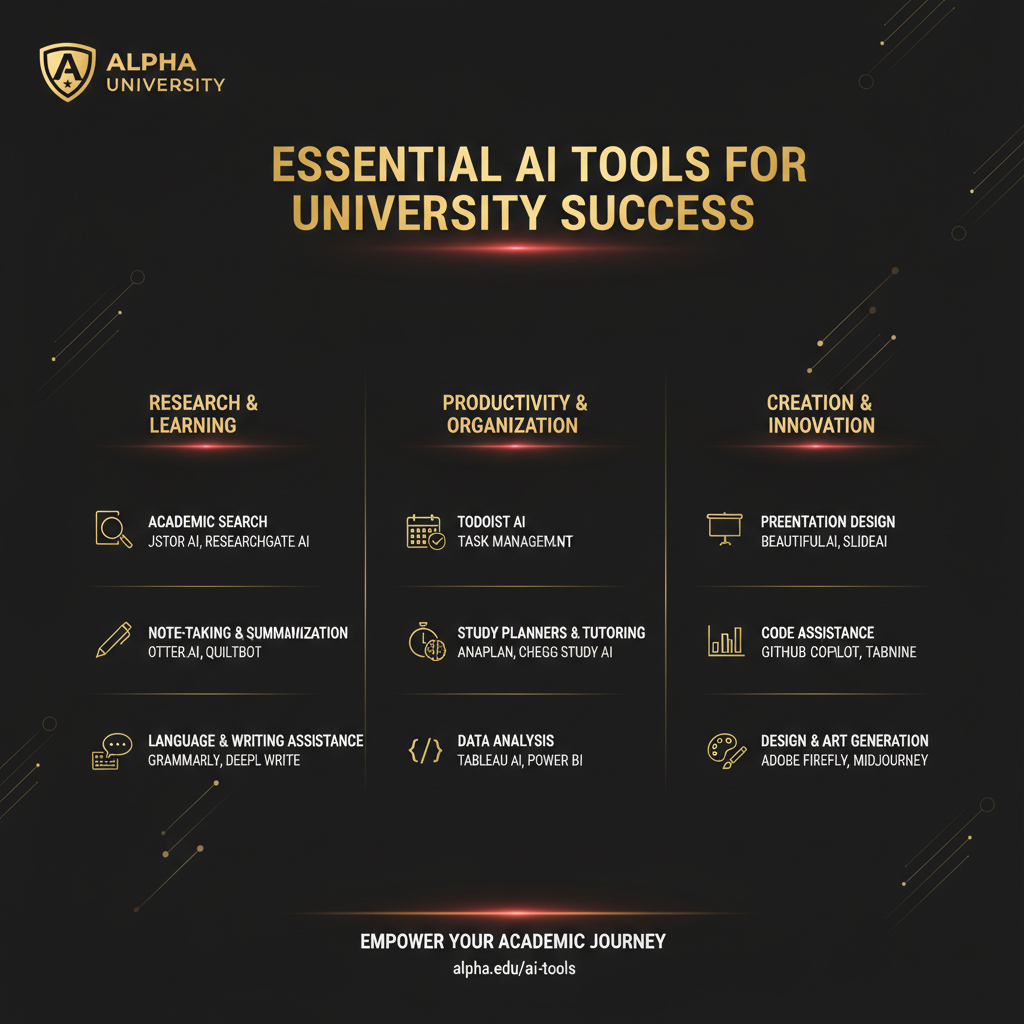
To succeed, you need to equip yourself with the right tools. Here is a breakdown of the most valuable AI-powered software for different aspects of your academic life.
1. Research and Reference Management
**Zotero:** While not a "new" AI tool, its browser connector and auto-citation features feel like magic. Zotero helps you collect, organize, and cite your research sources with incredible efficiency. It saves countless hours and prevents the headache of manually formatting bibliographies.
**Semantic Scholar:** This AI-powered research tool goes beyond simple keyword searches. It helps you find relevant papers, understand their context, and identify influential citations, giving you a powerful overview of the academic landscape on your topic.
2. Writing and Editing
**Grammarly:** More than just a spell-checker, Grammarly's AI-powered suggestions help improve clarity, conciseness, and tone. It acts as a 24/7 writing tutor, helping you polish your essays, emails, and reports to a professional standard.
**Generative AI (ChatGPT, Claude, Gemini):** These large language models are game-changers for brainstorming and overcoming writer's block. You can use them to generate outlines, ask clarifying questions about complex topics, or rephrase sentences for better flow. The key, as we'll discuss, is using them as a starting point, not a finishing one [1].
3. Note-Taking and Summarization
**Otter.ai:** This tool can transcribe lectures in real-time, allowing you to focus on the content instead of frantically typing notes. Afterward, you can search the transcript and even get an AI-generated summary, ensuring you never miss a key point.
**Genei:** Designed for students, Genei uses AI to summarize background reading and research articles in minutes. It can extract keywords, definitions, and arguments from multiple documents, radically speeding up your research process.
Navigating Academic Integrity: Using AI Tools Ethically
The most powerful tool is useless if you don't know how to use it correctly. The biggest misconception among students is that AI can be used for any task without consequence [3]. This is a dangerous assumption.
As Stanford University’s guide for students emphasizes, you *must* consult your instructor's course policy to understand if and how AI tools are permitted for your assignments [3]. The learning goals for a creative writing class are different from a computer science course, and AI usage policies will reflect that [3]. Unauthorized use of AI is often considered academic misconduct, with serious penalties.
Here’s the ethical framework you should adopt:
* **Augment, Don’t Automate:** Use AI to assist with your thinking, not replace it. Use it for brainstorming, summarizing, and improving your writing, but the core ideas and final words must be your own [1]. * **Attribute and Acknowledge:** If your instructor permits AI use, be transparent about how you used it. Proper citation and acknowledgment are key principles of academic integrity. * **Develop Your Skills:** The purpose of university is to develop your own critical thinking and analytical abilities. Relying too heavily on AI can stunt this growth. Learning to [Learn AI](/learn-ai) is about mastering the tool, not letting the tool master you.
Beyond the Classroom: AI for Career Preparation
The skills you build at university are meant to prepare you for a successful career. Today, proficiency in using AI tools is becoming a prerequisite in many fields. OneGoal highlights that AI can help students prepare for their careers by improving organization and communication skills [1].
Learning to use these tools ethically and effectively as a student is direct training for the modern workplace. You are not just writing a history paper; you are learning how to synthesize information and communicate complex ideas—skills that are amplified by the strategic use of AI. The students of today are part of the [Alpha Generation](/alpha-generation), natives in a world where AI is ubiquitous.
The Alpha Generation: Mastering AI for Lifelong Success
The AI revolution is here. For university students, it presents an incredible opportunity to learn faster, work smarter, and prepare for a future that will be intrinsically linked with artificial intelligence. The key is to move from being a passive user to a strategic operator—someone who understands both the capabilities and the ethical boundaries of these powerful tools.
At Alpha University, we believe that mastering AI is a fundamental component of a modern education. It’s not just about using a few apps; it’s about developing a new type of literacy. Our [AI University](/ai-university) is designed to equip you with the deep knowledge and practical skills to lead in the age of AI. By learning the principles behind these tools, you can stay ahead of the curve and transform a potential academic shortcut into a genuine intellectual superpower.