Foundational AI Skills for Future Career Success
Discover the essential AI skills you need to succeed in your future career. Learn how AI is transforming industries and what you can do to stay ahead.
Category: AI Knowledge
Foundational AI skills are now crucial for career readiness across all industries, representing a shift as significant as internet literacy was two decades ago [source]. These core competencies include not just technical know-how, but AI literacy, data analysis, prompt engineering, and an understanding of AI ethics. For students and professionals, developing these skills is no longer optional but essential for securing and advancing in the modern workforce [source].
Key Takeaways * AI proficiency is the new baseline for career readiness, comparable to computer literacy in the 2000s. * Key foundational skills include AI literacy, prompt engineering, data analysis, and ethical AI principles. * AI is not just for tech roles; it is being integrated into every industry, including healthcare, finance, and the arts. * Traditional workplace competencies like critical thinking and communication are not being replaced, but rather enhanced and reshaped by AI. * Building these skills requires a combination of formal education, hands-on practice, and a commitment to continuous learning.
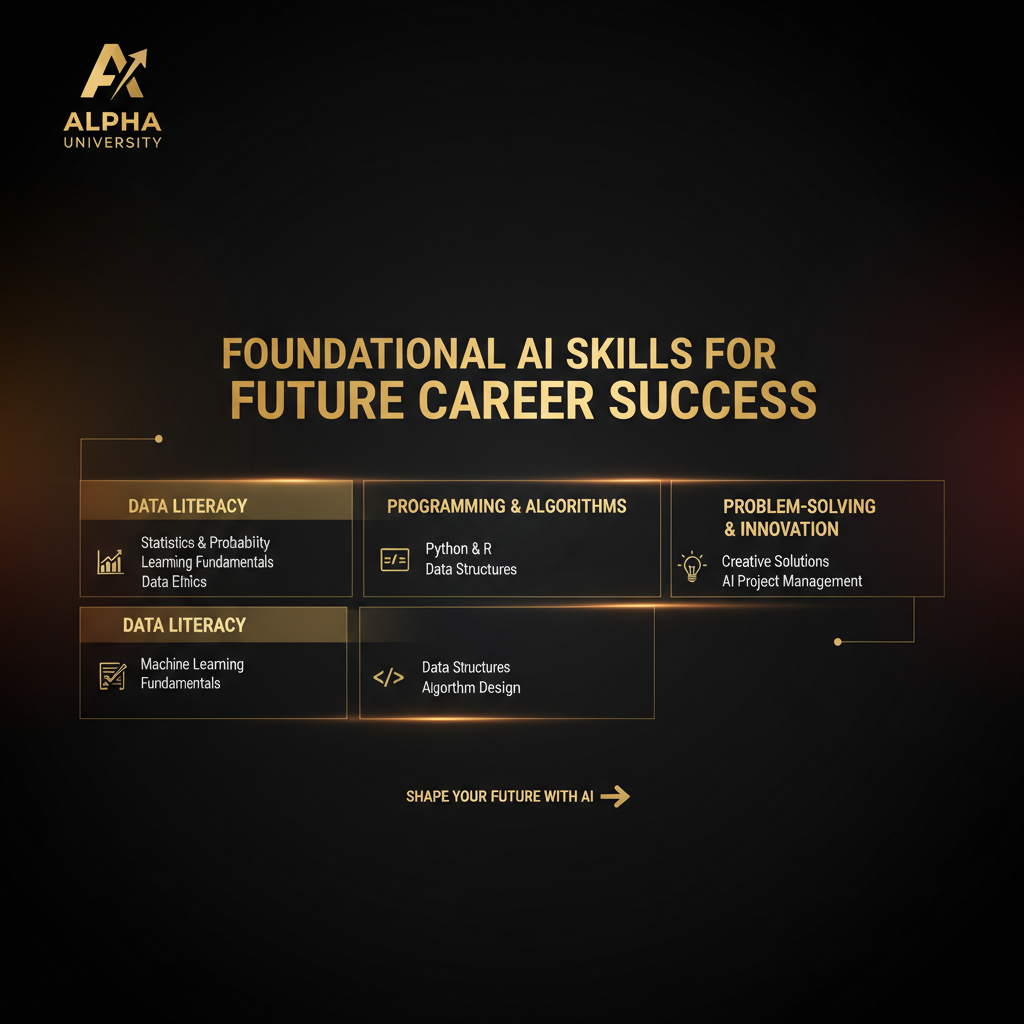
Why AI Skills Are No Longer Optional for Career Success
In 2005, knowing how to navigate the internet was becoming a non-negotiable skill for most professionals. Today, Artificial Intelligence has reached that same pivotal point [source]. What was once a niche specialty for data scientists and engineers is now a fundamental competency impacting every career path, from marketing and finance to healthcare and journalism [source].
Employers across all sectors are actively prioritizing candidates who possess [AI Skills](/ai-skills). The ability to understand, use, and collaborate with AI is a significant competitive advantage. Those without it risk being left behind as industries evolve at an unprecedented pace [source]. This isn't about everyone becoming an AI developer; it's about everyone being equipped to work alongside AI in their respective roles. Educational institutions, from K-12 to higher ed, are recognizing this shift and racing to integrate AI education to ensure their students are truly career-ready [source].
What Are the Foundational AI Skills?
To become career-ready in the age of AI, you don't need to be a machine learning expert. Instead, the focus is on a set of foundational, human-centric skills that allow you to leverage AI effectively and responsibly. These are the pillars that will support your career growth for years to come.
AI Literacy: The True Starting Point
Before you can use AI, you must understand it. AI literacy is the ability to grasp core AI concepts, know its capabilities and—just as importantly—its limitations. It means understanding the difference between generative AI and analytical AI, recognizing potential biases in AI outputs, and identifying tasks where AI can provide the most value.
Think of it like learning the rules of the road before getting behind the wheel. This conceptual understanding is the bedrock upon which all other [AI Skills](/ai-skills) are built. Without it, you are merely a button-pusher, unable to think critically or strategically about the tools you are using.
Prompt Engineering: Communicating with AI
If AI is a powerful engine, a well-crafted prompt is the key that starts it and the steering wheel that directs it. Prompt engineering is the skill of communicating with generative AI systems to get the most accurate, relevant, and creative outputs. It’s a blend of instruction, context-setting, and iteration.
Anyone can type a question into a chatbot. But a skilled professional knows how to frame a query, provide examples, define a persona, and refine their prompts to turn a generic answer into a strategic asset. As more of our work involves interacting with [AI Tools](/ai-tools), effective communication with them becomes a primary measure of our own effectiveness.
Data Literacy: Understanding AI's Language
AI is fueled by data. Therefore, a foundational understanding of data is essential for anyone looking to master AI. Data literacy in this context doesn't mean you need to be a data scientist. It means being able to:
* **Question the source:** Where did the AI get its data? Is it credible? * **Identify potential bias:** Could the training data reflect historical biases that are now skewing the output? * **Analyze the output:** Does the AI-generated information make sense? Can it be verified?
This skill connects directly to timeless competencies like critical thinking. It ensures you remain the human-in-the-loop, using your judgment to validate and apply AI-driven insights, rather than accepting them blindly [source].
AI Ethics: Navigating the New Frontier
As AI becomes more integrated into our lives, the ethical implications grow. A career-ready professional must be able to navigate these complex issues. This includes understanding:
* **Privacy:** How is user data being used to train and operate AI systems? * **Accountability:** Who is responsible when an AI makes a mistake? * **Transparency:** Can we understand how an AI arrived at a particular conclusion?
Being conversant in AI ethics is not just a moral imperative; it's a business one. Companies need employees who can help them deploy AI responsibly, mitigating risks and building trust with customers. At **Alpha University**, we embed ethical considerations into our curriculum, ensuring our students are prepared to lead with integrity.
How Traditional Competencies Evolve with AI
A common misconception is that AI will make human skills obsolete. The reality is that AI is augmenting them, creating a new synthesis of human and machine capability [source]. Core competencies like communication, teamwork, and critical thinking are becoming more valuable, but they must now be viewed through the lens of AI.
* **Critical Thinking evolves into AI-Assisted Critical Thinking:** Your ability to analyze a problem is now enhanced by AI's ability to process massive datasets. Your role shifts from finding the answer to asking the right questions and validating the AI-generated solution. * **Communication evolves into AI-Augmented Communication:** Your ideas can be clarified, translated, and formatted in seconds using AI tools. Your skill is in guiding the tool to capture your unique voice and strategic intent, and then adapting it for the perfect audience. * **Teamwork evolves into Human-AI Collaboration:** The concept of a "team" is expanding to include AI partners. Success depends on your ability to delegate tasks to the AI, know when human oversight is needed, and synthesize the work of both human and machine teammates [source].
How to Build Your Foundational AI Skills
Developing these skills is an active process. It requires intention, curiosity, and a commitment to lifelong learning. The journey to [Learn AI](/learn-ai) is accessible to everyone, regardless of their background.
1. **Formal Education:** Structured learning provides the comprehensive foundation needed to truly understand AI. Leading-edge programs, like those at **[AI University](/ai-university)**, are designed to build these foundational skills from the ground up, preparing students not just for their first job, but for a long-term career in an AI-driven world.
2. **Online Courses & Certifications:** Platforms like Coursera, edX, and others offer targeted courses on everything from AI fundamentals to prompt engineering. These are excellent for upskilling in a specific area.
3. **Hands-On Practice:** The most important step is to start using AI. Experiment with different [AI Tools](/ai-tools). Use them for brainstorming, writing, and problem-solving. The more you interact with these systems, the more intuitive your understanding will become.
4. **Stay Informed:** Follow AI researchers, publications, and thought leaders. The field is changing daily, and staying current is a skill in itself.
The Future of Work and the Alpha Generation
The workforce is in the midst of a paradigm shift. The [Alpha Generation](/alpha-generation), who will have grown up with AI as a constant presence, will enter the job market as AI natives. For career changers and students today, this means the window of opportunity to gain a competitive edge through AI skills is right now.
Building a foundational understanding of AI is not about catching up; it's about preparing for the future of work itself. It is the single most important investment you can make in your career readiness. By embracing a mindset of continuous learning and collaboration with AI, you are positioning yourself for sustained success and leadership in a world being reshaped by this transformative technology.