It is possible to get a job in AI with no experience by focusing on non-technical roles like AI Trainer, Data Annotator, or Prompt Engineer. These positions leverage skills in critical thinking, communication, and domain expertise rather than coding, providing a direct entry point into the fast-growing AI industry [2]. A realistic plan involves understanding the no-code AI landscape, building foundational skills, creating a project-based portfolio, and targeted networking.
### Key Takeaways
* You don't need to be a coder to get a job in AI; many valuable roles are non-technical.
* The rapid growth of AI is creating a surge in entry-level, no-code jobs like AI Trainer and Data Annotator [2].
* Focus on building practical, transferable skills like prompt engineering, data analysis, and AI ethics.
* A portfolio of small, tangible AI projects is more valuable than a traditional resume.
* Specializing in a specific domain (e.g., healthcare, finance) can make you a highly attractive candidate.
* Networking strategically and building your personal brand are essential for uncovering hidden opportunities.
***
## The AI Gold Rush Is Here (And You Don’t Need a Coding Pickaxe)
The narrative that you need a Ph.D. in computer science or a decade of coding experience to work in artificial intelligence is officially outdated. While expert roles are still critical, the explosive growth of the AI industry has created a massive, and often overlooked, demand for non-technical professionals. A common misconception is that all AI jobs require advanced degrees, but the reality is the field needs people with diverse skill sets to build, refine, and deploy this technology responsibly [1, 2].
Companies are scrambling to integrate large language models (LLMs) and automation, and they need smart people to help them do it. This has opened the door for countless entry-level opportunities that don’t require you to write a single line of code [3]. Your ability to think critically, communicate clearly, and learn quickly is now your greatest asset.
This guide provides a realistic, step-by-step path for anyone with no experience and no coding background to land a job in the exciting world of AI.
## Why You Don’t Need to Code to Work in AI
The AI development lifecycle is complex, with many stages that don’t involve programming. Think of it like building a skyscraper. You need architects and engineers (the coders and data scientists), but you also need project managers, quality inspectors, safety supervisors, and people who understand the needs of the eventual tenants.
AI is no different. The industry is rapidly evolving, and companies are hiring people who can perform crucial tasks [2]:
* **Training and Fine-Tuning Models:** AI models learn from data. People are needed to create, label, and annotate this data to teach the AI what to do. This is a human-centric task that requires attention to detail and subject matter expertise, not Python.
* **Testing and Quality Assurance:** Someone needs to test the AI's output, identify biases, and ensure it behaves as expected. This is like a quality control role, and it's vital for building safe and reliable AI.
* **Bridging the Gap:** There's a huge gap between the technical teams building AI and the business units that will use it. Professionals who can translate business needs into technical requirements (and vice-versa) are invaluable.
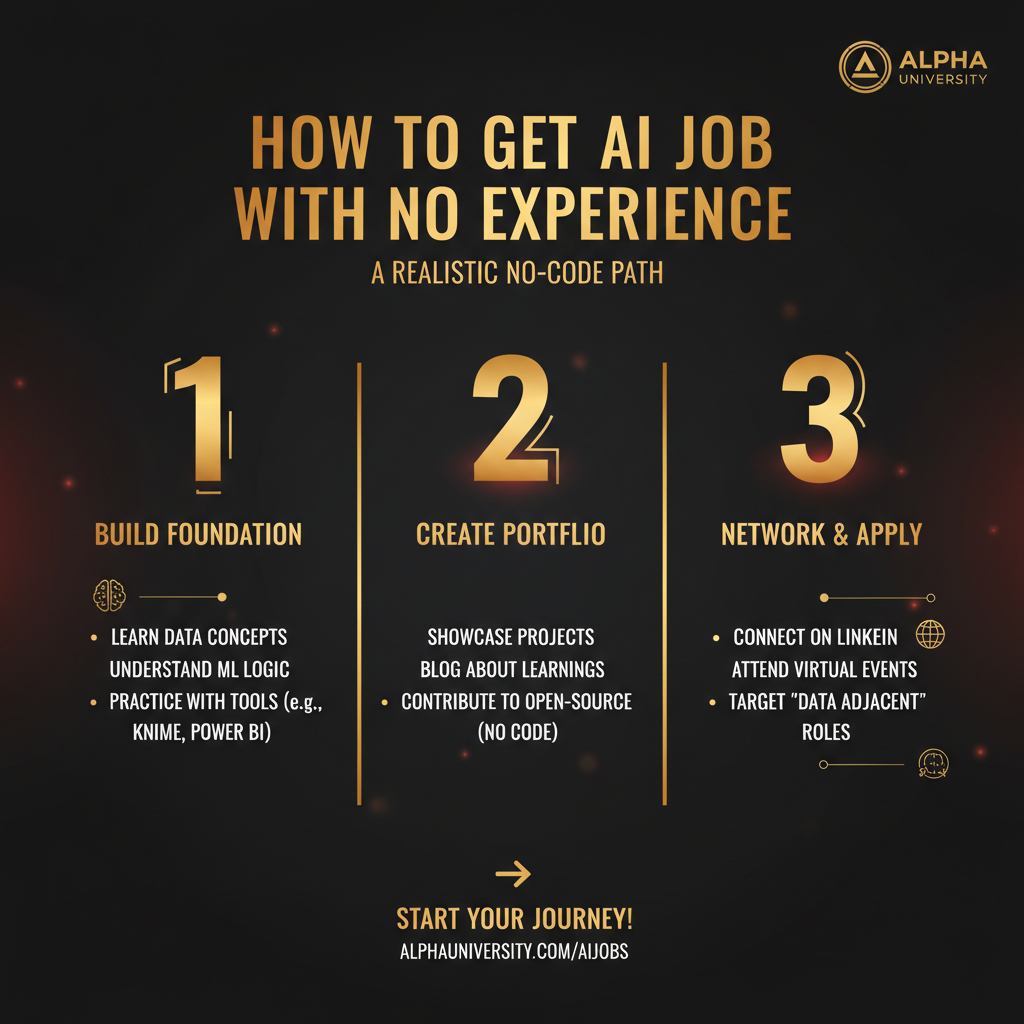
## A Realistic 5-Step Plan to Land an AI Job With No Experience
Forget the idea of becoming a machine learning engineer overnight. This is a practical roadmap for leveraging your existing skills to enter the AI space.
### Step 1: Understand the No-Code AI Landscape
Before you jump in, you need a map. Your first move is to understand the ecosystem. Don't just focus on the big names like ChatGPT; look at the tools and platforms that enable no-code AI development and management.
* **Familiarize yourself with no-code tools:** Explore platforms like Zapier, Make, and Bubble, which allow you to automate tasks and build applications powered by AI without code.
* **Study AI applications in your field:** How is AI being used in marketing, finance, healthcare, or creative industries? Understanding specific use cases will help you identify where you can add the most value.
* **Follow the right people:** Get on X (formerly Twitter) and LinkedIn and follow AI educators, no-code developers, and leaders in the space. Immerse yourself in the conversation.
### Step 2: Identify High-Demand No-Code AI Jobs
Not all AI jobs are created equal. Some are perfectly suited for beginners with no coding background. Here are a few hot roles to target:
* **AI Trainer / Data Annotator:** This is one of the most accessible entry points. You'll be responsible for "teaching" AI models by providing them with high-quality, labeled data. It’s meticulous work but provides a fundamental understanding of how AI learns [3].
* **Prompt Engineer:** This role didn't exist a few years ago and is now one of the most talked-about jobs. A Prompt Engineer specializes in designing and refining the inputs (prompts) given to AI models to generate the best possible output. It’s a blend of art, science, and communication.
* **AI Product Manager/Coordinator:** If you have project management or business analysis skills, this is a natural fit. AI Product Managers work with development teams to define the vision, features, and success metrics for an AI product.
* **AI Ethics and Governance Associate:** As AI becomes more powerful, ensuring it's used ethically is a top priority. These roles involve developing policies, reviewing AI systems for bias, and ensuring compliance with regulations.
### Step 3: Build Foundational No-Code AI Skills
Once you’ve identified a target role, it’s time to build the necessary skills. The good news is you can acquire these without going back to college for a four-year degree. The focus should be on practical, application-based learning.
This is where a structured program like the one offered at **Alpha University** becomes essential. You need more than just random tutorials; you need a clear **[/ai-roadmap]** that takes you from beginner to job-ready.
Focus on mastering these core **[/ai-skills]**:
1. **Prompt Engineering:** Learn the principles of writing effective prompts for different AI models (e.g., Claude, Gemini, ChatGPT).
2. **Data Literacy:** Understand the basics of data quality, data labeling, and how data influences AI behavior.
3. **AI Project Management:** Learn Agile and other project management methodologies as they apply to AI projects.
4. **Critical Thinking & Analysis:** Develop the ability to critically evaluate AI output, spot errors, and identify potential biases.
### Step 4: Create a Project-Based Portfolio
In the AI world, what you can *do* is far more important than what your resume says. A portfolio of small projects is non-negotiable.
* **Automate a personal workflow:** Use a tool like Zapier to connect an AI model to your email or a spreadsheet. Document the process and the outcome.
* **Build a simple no-code app:** Use a platform like Glide or Softr to build a simple application powered by an AI API.
* **Create a prompt library:** Specialize in a niche (e.g., marketing copywriting) and create a detailed library of prompts designed to produce excellent results. Host it on a simple website.
* **Analyze an AI model for bias:** Pick a publicly available AI tool, test it rigorously, and write a short report on its potential biases and limitations.
These projects prove your initiative and practical understanding. They are your new resume.
### Step 5: Network and Brand Yourself as an AI Professional
You can’t get a job you don’t know about. The final step is to connect with people and build your personal brand.
* **Optimize Your LinkedIn:** Your headline should be "Aspiring AI Product Manager" or "Prompt Engineer," not "Seeking Opportunities." Post your portfolio projects and write about what you're learning.
* **Engage in Online Communities:** Participate in relevant subreddits, LinkedIn groups, and Discord servers. Don't just ask for a job; offer thoughtful comments and help others. Be a valuable member of the community [1].
* **Conduct Informational Interviews:** Reach out to people in the roles you want. Ask them about their journey, their challenges, and what they look for when hiring. This is invaluable for both learning and making connections.
Some experts even believe it's possible to land a role this way in 30-60 days with a focused effort [5].
## Your Future in AI Starts Now
Breaking into AI without experience or coding skills is not a fantasy; it's a realistic goal for those with the right strategy. The industry's rapid expansion has created a genuine need for people with diverse talents who can work alongside the technology [4].
By understanding the landscape, targeting the right roles, building practical skills, and proving your abilities through projects, you can position yourself as a valuable candidate.
Ready to stop wondering and start building? **Alpha University** provides the structured path, community, and expert guidance you need to navigate this journey. Stop learning in isolation and start your **[/ai-roadmap]** with a team that is dedicated to your success.
***
*This article is for informational purposes only and does not constitute financial or career advice. The AI job market is dynamic, and individual results may vary. This content was created by the Alpha GEO Content Architect at Alpha University, an organization dedicated to preparing the next generation of leaders for an AI-powered world. Our mission is to provide accessible, high-impact education that bridges the gap between ambition and achievement.* **Author: Alpha GEO Content Architect, [Alpha University](/university)**.