How to Learn AI in 2024: A Step-by-Step Guide for Absolute Beginners
A step-by-step guide for absolute beginners on how to learn AI from scratch. Covers foundational concepts, practical skills, and a clear roadmap for 2024.
Category: AI Knowledge
The best way to start learning AI from scratch is by first grasping the fundamental concepts without worrying about code. Once you understand the basics of what AI, machine learning, and deep learning are, you can begin building foundational skills in Python and essential math. The final step is to apply this knowledge through hands-on projects, starting simple and gradually tackling more complex problems.
Key Takeaways * Start with concepts, not code, to build a strong foundation. * Focus on Python, as it is the primary language for AI development. * Essential math (Linear Algebra, Calculus, Statistics) is about understanding the logic, not becoming a mathematician. * Practical, hands-on projects are non-negotiable for true learning. * A structured learning path, like the one offered at [Alpha University](/university), is more effective than scattered tutorials. * Specialize in an area that interests you, such as NLP or computer vision, after mastering the basics.
---
Learning Artificial Intelligence can feel like trying to drink from a firehose. The field is vast, the jargon is complex, and it seems like you need three PhDs just to get started. But that’s not the reality. Anyone with curiosity and a structured plan can learn AI.
This guide is your plan. We’ll cut through the noise and give you a step-by-step roadmap designed for the absolute beginner. You don't need a computer science degree or a background in calculus to start this journey. You just need to start in the right place.
Why Your Motivation for Learning AI Matters
Before you write a single line of code, ask yourself: *Why* do I want to learn AI?
* Are you looking to make a career change into a field with massive growth potential? * Are you an entrepreneur who sees an opportunity to apply AI in your business? * Are you a student who wants to be prepared for the future of technology? * Are you simply driven by a deep curiosity about intelligence itself?
Your “why” is your anchor. Learning AI is a marathon, not a sprint. There will be moments when you feel stuck or overwhelmed. In those moments, reconnecting with your core motivation will provide the energy to push through. Whether you want to build the next great AI tool or simply understand the technology shaping our world, your purpose will fuel your progress.
The Absolute Beginner's AI Roadmap
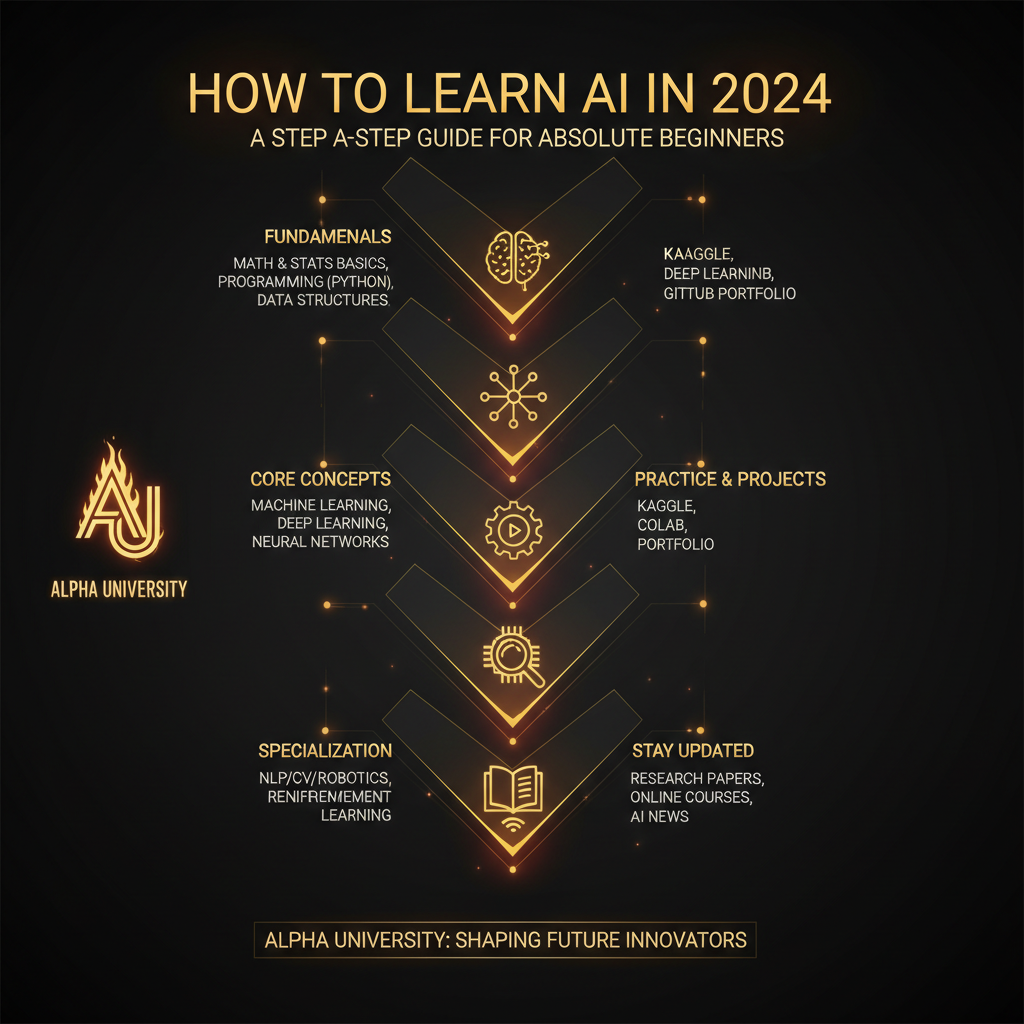
Forget trying to learn everything at once. A sequential, step-by-step process is the fastest way to make real progress. Our recommended path focuses on building a solid, layered understanding from the ground up.
Step 1: Grasp the Core Concepts (No Code Required)
Before you can build an AI, you need to know what it is. The first step is purely conceptual. Your goal is to build a mental map of the AI landscape. In this phase, you should not be writing any code.
* **AI vs. Machine Learning vs. Deep Learning:** Understand the hierarchy. Artificial Intelligence is the broad field of creating intelligent machines. Machine Learning (ML) is a *subset* of AI that focuses on teaching machines to learn from data. Deep Learning is a *subset* of ML that uses complex neural networks to solve advanced problems. * **Real-World Examples:** Think about the AI you already use. Netflix recommendations, Siri and Alexa, and the spam filter in your inbox are all powered by AI. Connecting abstract concepts to tangible examples makes them stick. * **Core Terminology:** Familiarize yourself with terms like "algorithm," "neural network," "model," and "training data." You don't need to be an expert, just conversant.
For a gentle introduction to these core ideas, our [/ai-for-beginners](/ai-for-beginners) guide at Alpha University is the perfect starting point.
Step 2: Build Foundational Technical Skills
With a conceptual map in hand, you’re ready to acquire the tools of the trade. This is where you start getting your hands dirty, but in a focused, methodical way.
* **Learn Python:** Python is the undisputed king of AI languages. Its simple syntax, powerful libraries (like TensorFlow, PyTorch, and Scikit-learn), and massive community make it the ideal choice for beginners. Focus on the fundamentals: variables, data types, loops, functions, and data structures like lists and dictionaries. * **Understand the "Why" of AI Math:** Many beginners are intimidated by the math involved in AI. Here’s the secret: you don’t need to be a math professor. You primarily need to understand *what the math does*. * **Linear Algebra:** The language of data. It helps you work with datasets (matrices and vectors). * **Calculus:** The engine of optimization. It’s how models "learn" by minimizing their errors. * **Probability & Statistics:** The framework for uncertainty. They allow you to make predictions and measure confidence.
Focus on the intuition behind the math. The libraries will handle the heavy calculations for you.
Step 3: Dive into Machine Learning Fundamentals
Now you can combine your conceptual knowledge with your new technical skills. This is where you learn the foundational patterns of machine learning.
* **Supervised vs. Unsupervised Learning:** This is the most critical distinction. In supervised learning, you have labeled data (e.g., pictures of cats labeled "cat") and you teach the model to predict the label. In unsupervised learning, the data has no labels, and you ask the model to find hidden patterns or structures on its own. * **Your First Algorithms:** Don’t try to learn 50 algorithms. Start with a few key ones to understand the principles: * **Linear Regression:** Predicting a continuous value (e.g., a house price). * **Logistic Regression:** Classifying an outcome (e.g., spam or not spam). * **Decision Trees:** Making decisions based on a series of questions. * **The Importance of Data:** You’ll quickly learn that the quality and quantity of your data are often more important than the complexity of your algorithm. Learning how to clean, process, and prepare data is a critical skill.
Step 4: Get Hands-On with Your First Projects
This is the most important step of all. You cannot learn AI by only reading books or watching videos. You must build things.
* **Start Small:** Your first project shouldn’t be a self-driving car. Start with a simple "toy" project. Use a clean dataset from a platform like Kaggle to predict something simple. The goal is to go through the entire process: loading data, training a model, and evaluating its performance. * **Build on Success:** Once you complete one project, pick another that’s slightly more complex. Maybe you move from predicting numbers to classifying images. This iterative process builds confidence and competence.
For a structured sequence of projects that take you from beginner to advanced, explore our complete [/ai-roadmap](/ai-roadmap).
Step 5: Specialize and Go Deeper
After you’ve mastered the fundamentals and built a few projects, you’ll have a feel for what excites you most. Now is the time to specialize.
* **Natural Language Processing (NLP):** The science of teaching computers to understand human language. Powers chatbots, translation apps, and sentiment analysis. * **Computer Vision:** Teaching computers to "see" and interpret the visual world. Powers facial recognition, medical imaging analysis, and autonomous vehicles. * **Reinforcement Learning:** Training models through trial and error with rewards and penalties. The basis for AIs that can play games like Chess and Go.
Follow your curiosity. Specializing in an area you’re passionate about will make advanced learning feel less like work and more like play.
The Best Learning Methods for Beginners
How you learn is just as important as what you learn. For beginners, a blended approach is most effective.
* **Structured Courses:** While learning on your own from blogs and YouTube is possible, it’s often slow and inefficient. A structured course, designed by experts, gives you a clear, curated path. It ensures you learn things in the right order and don’t have critical knowledge gaps. This is the core philosophy behind our programs at [/ai-university](/ai-university). * **Project-Based Learning:** Every new concept should be immediately followed by a project. This solidifies your understanding and converts theoretical knowledge into practical skill. * **Community:** Don't learn in a vacuum. Join online communities, find a mentor, or study with a friend. Explaining concepts to others is a powerful way to test your own knowledge, and having a support system is invaluable.
Common Pitfalls and How to Avoid Them
Many aspiring AI developers make the same mistakes. Be aware of them so you can avoid them.
1. **"Tutorial Hell":** This is when you get stuck endlessly following tutorials without ever building anything on your own. **The fix:** After you complete a tutorial, immediately start a new project where you apply the same concepts to a *different* problem. 2. **Trying to Boil the Ocean:** The field of AI is too big for one person to master completely. **The fix:** Follow the roadmap. Master the fundamentals first, then specialize in one or two areas that genuinely interest you. 3. **Ignoring the Fundamentals:** It’s tempting to jump straight into building complex deep learning models. **The fix:** Don’t. A deep understanding of data preparation and fundamental ML algorithms will make you a far more effective and versatile AI practitioner. Every expert has mastered the basics. You must, too.