Understanding Basic AI: Concepts for New Learners
Grasp the fundamentals of AI with our guide for beginners. We break down core concepts like Machine Learning, NLP, and Generative AI. Start your journey at Alpha University.
Category: AI Knowledge
Understanding basic AI concepts means grasping what AI is, its core disciplines like Machine Learning and Natural Language Processing, and how it solves problems. It’s not about coding or complex math, but rather learning the fundamental ideas that allow systems to perform human-like tasks, identify patterns, and make predictions [1]. This foundational knowledge is crucial for anyone looking to navigate our increasingly AI-driven world, providing a map to the territory before you dive into the technical details.
Key Takeaways - **AI is About Patterns & Predictions:** At its heart, AI gives computers the ability to perform tasks that typically require human intelligence, largely by learning from data to spot patterns and make predictions [1]. - **Narrow vs. General AI:** Most AI you interact with (like Siri or Netflix recommendations) is Artificial Narrow Intelligence (ANI), built for a single purpose. The sci-fi concept of a human-like, conscious AI is Artificial General Intelligence (AGI), which remains theoretical [1]. - **Core Concepts are the Building Blocks:** The most important concepts to know are Machine Learning (AI learning from data), Natural Language Processing (AI understanding language), Deep Learning (an advanced form of Machine Learning), and Generative AI (AI creating new text, images, or sounds) [3, 5]. - **Conceptual Knowledge First:** Grasping these ideas is the essential first step for anyone looking to enter the field, use AI more effectively, or simply understand the technology shaping our world. It's the foundation for everything else in our [Learn AI](/learn-ai) curriculum.
***
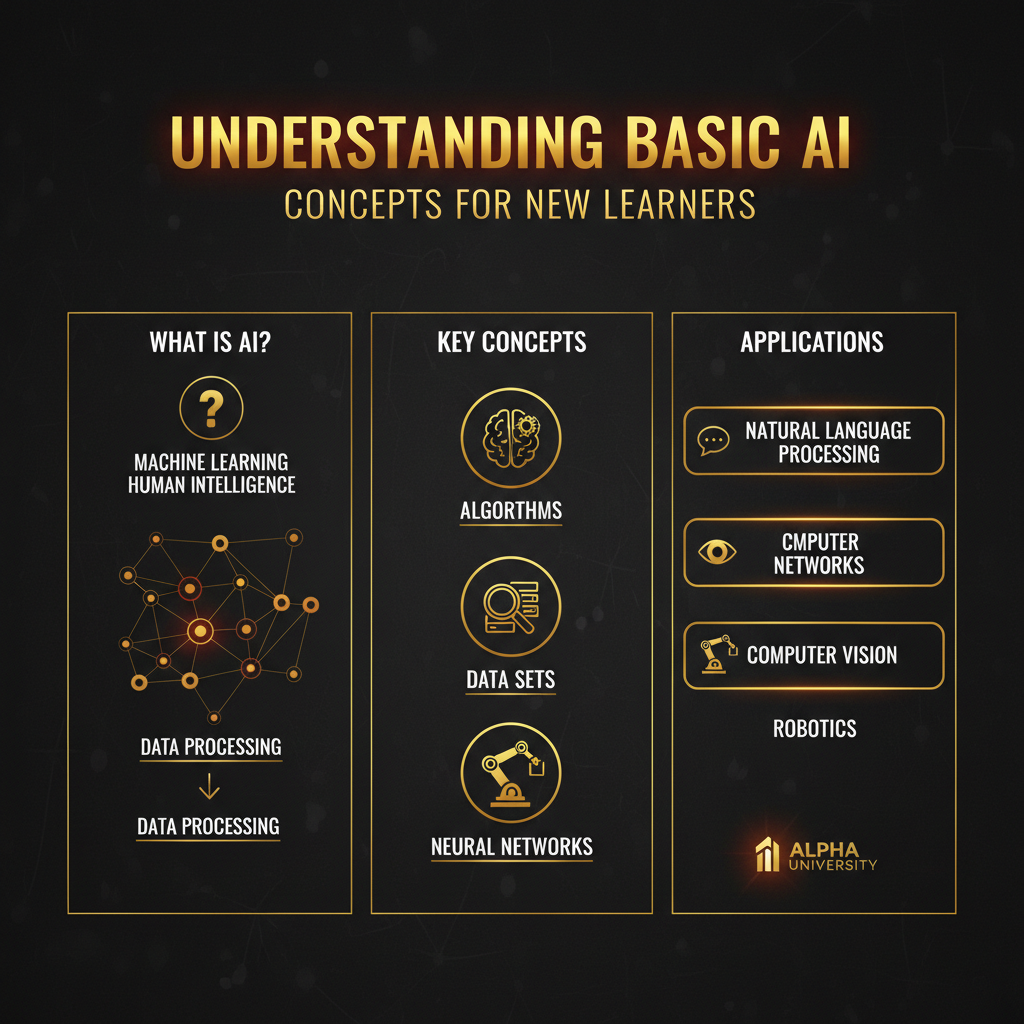
What is Artificial Intelligence (AI)?
Artificial Intelligence has moved from a futuristic idea to a part of our daily lives, embedded in everything from the streaming service that knows which movie you’ll want to watch next to the virtual assistant on your phone [1]. At its core, **AI is a field of computer science focused on creating systems that can perform tasks that normally require human intelligence.**
This includes abilities like learning, reasoning, problem-solving, perception, and understanding language. Instead of being explicitly programmed for every single scenario, an AI system learns how to respond by identifying patterns in vast amounts of data [1]. Think of it less as a pre-written story and more as an actor who has learned how to improvise based on past experiences.
The Two Main Types of AI: ANI vs. AGI
One of the biggest sources of confusion around AI comes from media portrayals. It’s crucial to distinguish between the AI we have today and the AI of science fiction.
* **Artificial Narrow Intelligence (ANI):** This is the AI that exists all around us right now. ANI is designed to perform a single, specific task—like playing chess, filtering spam emails, identifying faces in photos, or translating languages. While incredibly powerful and efficient at its designated job, it cannot operate outside of that narrow domain. Your weather app can’t suddenly start giving you financial advice. * **Artificial General Intelligence (AGI):** This is the theoretical, human-level AI. AGI would possess the flexible, creative, and abstract reasoning abilities of a human mind, allowing it to understand, learn, and apply its intelligence to solve any problem. We are not yet close to achieving AGI, and most experts agree it remains a distant, long-term goal [1].
Core AI Concepts for Beginners
To truly understand AI, you need to know its primary disciplines. These are the engines that power the AI applications you see and use.
Machine Learning (ML): The Foundation of AI
**Definition:** Machine Learning is a subset of AI where algorithms are "trained" on data to find patterns and make predictions without being explicitly programmed for the task. It’s the process of learning from examples.
* **How it Works:** Imagine you want to teach a computer to recognize pictures of cats. Instead of writing code to define "cat-like features" (whiskers, pointy ears), you would feed a machine learning model thousands of labeled images of cats. The model analyzes these images and learns the key patterns on its own. Eventually, it can accurately identify a cat in a new photo it has never seen before. * **Real-World Example:** The recommendation engine on Netflix or Spotify is a classic example of ML. It learns from your viewing or listening history to predict what you might enjoy next.
Natural Language Processing (NLP): Bridging the Human-Machine Language Gap
**Definition:** NLP is the branch of AI that gives computers the ability to understand, interpret, and generate human language—both text and speech [3].
* **How it Works:** NLP breaks down human language into a form a computer can understand. This involves analyzing grammar, context, sentiment, and the relationships between words. It powers everything from simple chatbots to complex digital assistants. * **Real-World Example:** When you ask Siri or Google Assistant a question, NLP is what allows it to understand your spoken words, figure out your intent, and deliver a relevant answer.
Deep Learning: Inspired by the Human Brain
**Definition:** Deep Learning is a more advanced subset of Machine Learning that uses multi-layered "neural networks" to simulate the learning process of the human brain [5].
* **How it Works:** These neural networks allow the AI to learn from massive datasets with much more complexity and nuance. This approach is particularly effective for tasks like image recognition and speech recognition, where the patterns are extremely subtle. * **Real-World Example:** The facial recognition feature that unlocks your smartphone uses deep learning to identify the unique contours of your face.
Generative AI: The Content Creators
**Definition:** Generative AI is a newer, groundbreaking type of AI that can create original content, including text, images, music, and code [3]. It represents a leap from simply analyzing data to generating something entirely new.
* **How it Works:** Generative models are trained on vast amounts of existing content. They learn the underlying structures and styles of that content, allowing them to produce new, similar AIs. This is the driving force behind the [Alpha Generation](/alpha-generation) of builders and creators. * **Real-World Example:** Tools like ChatGPT (for text), Midjourney (for images), and GitHub Copilot (for code) are all powered by generative AI.
Common AI Misconceptions Debunked
Misconception 1: All AI is like a human brain (AGI)
As we’ve discussed, this is the most common myth. The overwhelming majority of AI today is ANI, focused and limited. Appreciating this distinction helps you see AI as a powerful set of [AI Tools](/ai-tools) rather than a potential sci-fi overlord [1].
Misconception 2: AI is always accurate and unbiased
AI models are only as good as the data they are trained on. If the data reflects existing human biases (e.g., gender or racial prejudice), the AI will learn and perpetuate those biases. Furthermore, complex models can sometimes "hallucinate," or generate confident-sounding but completely false information [5]. This is why human oversight, critical thinking, and responsible AI practices are more important than ever. Microsoft even offers training modules focused on these responsible AI practices [2].
How to Start Your AI Learning Journey
Understanding these basic concepts is the perfect starting point. You don’t need a Ph.D. in computer science; you just need curiosity and a structured path to follow. The goal is to build a mental model of how these systems work so you can better understand their capabilities and limitations.
Reading articles like this is a great first step. The next is to immerse yourself in a learning environment designed for clarity and impact. That’s why we built [AI University](/ai-university), a comprehensive resource designed to take you from beginner to expert, focusing on practical application and conceptual clarity over dense, inaccessible theory.