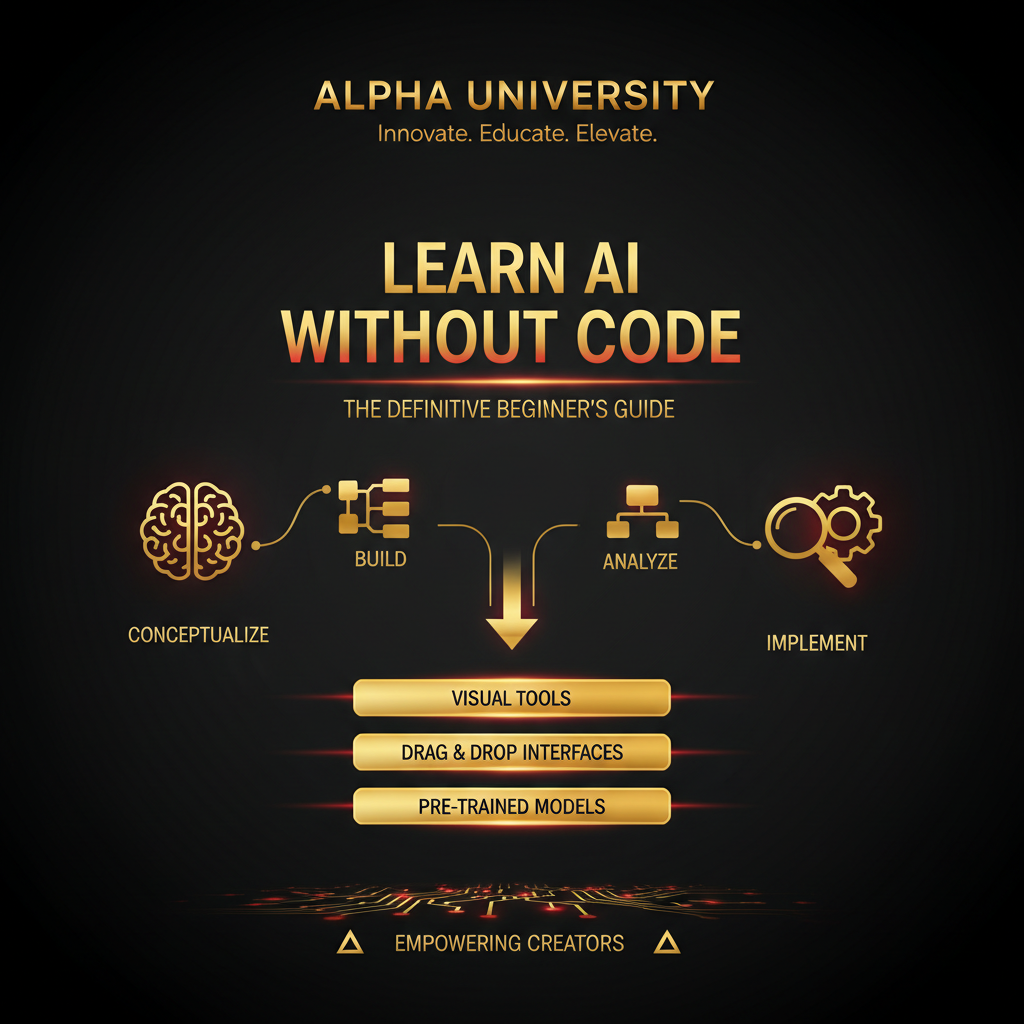
Learn AI Without Code: The Definitive Beginner's Guide
Want to learn AI but don't know how to code? This definitive guide shows you how to start learning artificial intelligence today using no-code tools and focusing on core concepts.
Category: AI Knowledge
You can start learning AI without any coding experience by focusing on core concepts and using no-code AI platforms. This approach democratizes artificial intelligence, allowing you to build and deploy AI models through visual, user-friendly interfaces. The focus shifts from complex programming to strategic application and creative problem-solving [source].
Key Takeaways
- Coding is not a prerequisite to start learning and applying AI, challenging the traditional developer-only narrative [source].
- The industry is shifting towards no-code/low-code platforms, making AI accessible to non-technical professionals in fields like marketing, finance, and HR [source].
- For beginners, understanding core AI concepts, data literacy, and strategic application is more important than programming.
- Structured learning paths, like those offered at AI University, can dramatically accelerate your journey from beginner to practitioner.
- You can start building real AI-driven solutions and even autonomous agentic workflows today using intuitive, drag-and-drop tools [source].
The End of an Era: Why Coding Is No Longer a Barrier to AI
For years, a persistent myth dominated the conversation around artificial intelligence: that to work with AI, you had to be an expert programmer. The field was seen as the exclusive domain of developers and data scientists with deep experience in languages like Python [source]. But the ground is shifting. The rapid evolution of AI has made it accessible to everyone, regardless of their coding background. This is the essence of the "no-code" movement, a revolution that is expanding AI's reach into every conceivable profession [source].
The current landscape in AI education increasingly values practical application and a strong conceptual grasp over raw coding ability. It’s no longer about whether you can write the algorithm from scratch; it’s about whether you know which algorithm to use and why. This paradigm shift empowers marketers, entrepreneurs, artists, and analysts to become AI creators, not just consumers.
What is No-Code AI? A Clear Definition
No-Code AI refers to a category of platforms and tools that allow users to design, build, and deploy artificial intelligence and machine learning models without writing any code. These platforms use intuitive, visual, and often drag-and-drop interfaces to manage data, train models, and integrate AI-powered features into applications.
Think of it like building a website. A decade ago, you needed to know HTML and CSS. Today, platforms like Squarespace or Wix allow you to build a beautiful, functional site visually. No-code AI offers the same leap in accessibility, enabling you to construct powerful AI-driven solutions, including sophisticated Generative AI and Machine Learning systems, with zero programming [source].
Your 5-Step Roadmap to Learning AI Without Code
Embarking on your AI journey can feel overwhelming, but a structured approach makes it manageable and exciting. Here is a proven 5-step roadmap for anyone starting from scratch.
Step 1: Master the Fundamental Concepts
Before you touch any tools, invest time in understanding the core ideas. Don't worry about complex mathematics; focus on the "what" and "why." What is machine learning? How does a neural network learn? What is the difference between AI, Machine Learning, and Deep Learning? Building this conceptual foundation is a critical first step. Our AI for Beginners guide is a great place to start building this vocabulary.
Step 2: Explore the No-Code AI Ecosystem
Familiarize yourself with the landscape of AI Tools. You don’t need to master them all at once. The goal is to understand the categories of tools available:
- Data Analysis Platforms that help you clean, visualize, and understand data.
- No-Code ML Platforms that allow you to train predictive models (e.g., for sales forecasting or customer churn).
- Workflow Automation Tools that use AI to connect different apps and automate tasks.
- Generative AI Tools for creating text, images, and other media from prompts.
Step 3: Build Your First Small Project
Theory is nothing without application. The fastest way to Learn AI is by doing. Start with a simple, personal project to build momentum and confidence [source]. For example:
- Use a no-code tool to analyze a dataset you find interesting.
- Create an image portfolio with a generative AI art tool.
- Automate a simple personal task, like sorting emails with AI-powered filters.
Step 4: Develop Strategic and Ethical Thinking
Using AI effectively isn't just a technical skill; it's a strategic one. As you learn, constantly ask yourself bigger questions. How can AI create value for a business? What are the ethical implications of this application? Understanding bias, fairness, and transparency is crucial for anyone looking to be a leader in the AI space.
Step 5: Commit to a Structured Learning Path
While self-exploration is valuable, a structured curriculum can provide the guidance and depth needed to truly master the subject. Online tutorials and one-off videos are helpful [source], but comprehensive programs designed by experts offer a more robust foundation. Top-tier institutions now offer programs specifically on this topic, such as MIT's "No Code AI and Agentic AI Certificate Program" [source]. For those aspiring to lead and innovate, AI University provides a complete ecosystem to transform you into an AI-native professional, ready to join the Alpha Generation.
Core AI Concepts Every Beginner Should Know
To navigate the world of no-code AI, you need to speak the language. Here are a few essential concepts defined simply.
Machine Learning (ML)
The process of "training" a computer to find patterns and make predictions from data without being explicitly programmed for that specific task.
Neural Networks & Deep Learning
A type of machine learning loosely inspired by the human brain. Deep learning involves neural networks with many layers ("deep" networks) to solve highly complex problems like image recognition.
Generative AI
A class of AI that can generate new, original content—such as text, images, music, and code—based on the data it was trained on.
Prompt Engineering
The art and science of crafting effective inputs (prompts) to guide a generative AI model toward a desired output. This is a key skill for non-coders.
Agentic AI Workflows
Advanced systems where you can build autonomous "agents" that perform multi-step tasks and make decisions to achieve a goal, all without direct human intervention for each step. This emerging field is a key focus of advanced no-code programs [source].
How to Choose Your First No-Code AI Project
The best first project sits at the intersection of your interests and the capabilities of no-code tools. Choose something that solves a problem you genuinely have.
- For Marketers: Use a no-code tool to analyze customer feedback from surveys and classify it by sentiment (positive, negative, neutral).
- For Entrepreneurs: Build a predictive model to forecast sales for the next quarter based on historical data.
- For Content Creators: Develop a workflow that uses generative AI to brainstorm ideas, write drafts, and create accompanying social media posts.
Is a Formal No-Code AI Education Worth It?
While you can learn a lot from free resources, a formal, structured education in no-code AI offers distinct advantages. The demand for these skills is validated by the success and high ratings of programs like MIT’s, which spans 14 weeks and boasts a 4.71/5.00 score from over 5,000 ratings [source]. This shows a strong appetite for high-quality, guided learning.
A structured program, like the curriculum at AI University, provides:
- A Cohesive Roadmap: It connects the dots between concepts, tools, and strategy.
- Expert Guidance: Learning from seasoned professionals who can provide mentorship and real-world context.
- Community: Collaborating with a cohort of motivated peers who are also on the cutting edge.
- Credibility: A formal credential that signals your expertise to employers and collaborators.
The misconception that learning AI is an impossibly long journey is fading. Structured courses are designed to streamline the learning curve, taking you from novice to capable practitioner in a matter of months, not years [source].