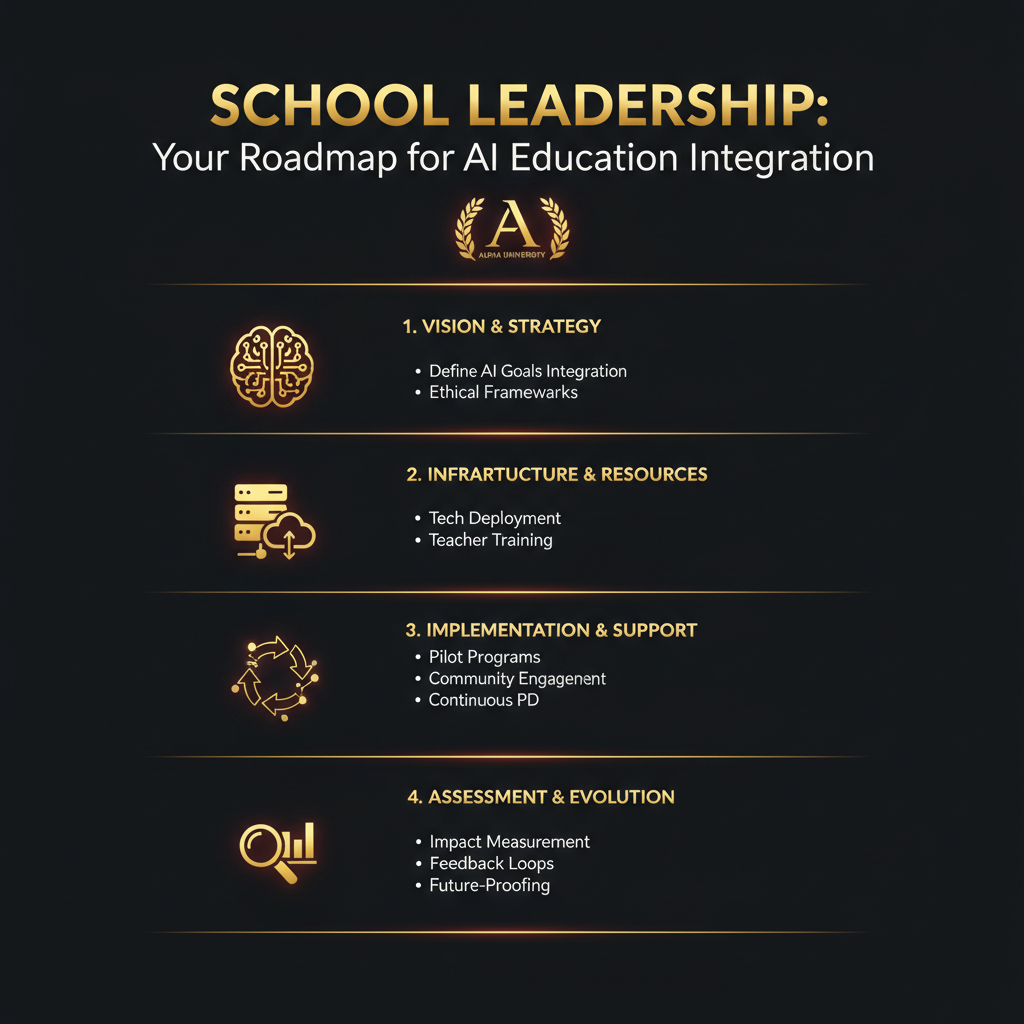
School Leadership: Your Roadmap for AI Education Integration
The definitive step-by-step roadmap for school and district leaders to integrate AI successfully. Learn the phases, from foundational planning to full-scale implementation.
Category: AI Knowledge
Integrating AI into education requires a strategic, phased roadmap, not a simple switch. This involves establishing a foundation of AI literacy, developing clear policies with stakeholder input, executing robust professional development for staff, and continuously evaluating the implementation. School leaders must guide their institutions through this structured process to harness AI's benefits while managing its risks.
Key Takeaways * AI integration is not a linear process but a journey through various strategic phases and psychological stages among educators. * Only 26 U.S. states have issued AI guidance, leaving a significant support gap for schools [source]. * A successful roadmap includes 5 key phases: Foundation, Strategy Development, Professional Development, Implementation, and Evaluation. * Teacher training is a critical success factor, yet only half of educators had received AI training by late 2025 [source]. * Leadership's role is to provide a structured approach, foster a culture of responsible experimentation, and ensure equitable access to AI tools and knowledge.
---
Why Your School Needs an AI Roadmap Now
The integration of artificial intelligence into education is well underway. A staggering 86% of education organizations are already using AI, reshaping learning environments and administrative tasks [source]. However, adoption doesn't equal strategy. Many schools are navigating this new terrain without a map, leading to inconsistent application, inequity, and missed opportunities.
As of April 2025, a mere 26 U.S. states have provided any official guidance on AI in education, highlighting a critical support vacuum for school leaders [source]. This lack of direction is felt most acutely in high-poverty schools, where only 13% of principals report receiving AI guidance, compared to 25% in more affluent districts [source].
Without a clear [AI Roadmap](/ai-roadmap), schools risk falling behind, failing to prepare the **[Alpha Generation](/alpha-generation)** for an AI-native future. A strategic, comprehensive plan is not just an option—it’s an imperative for responsible and effective leadership.
Understanding the Four Stages of AI Adoption
A common mistake is viewing AI integration as a simple on/off switch. The U.S. Department of Education suggests that educators move through various "psychological stage frameworks" when confronting new technology [source]. Understanding these stages is crucial for leading your team effectively:
1. **Enthusiastic Adoption:** These are the pioneers, eager to experiment and integrate AI into their classrooms. 2. **Curiosity and Cautious Optimism:** This group is interested but needs guidance, evidence of efficacy, and support to move forward. 3. **Ambivalence and Skepticism:** These educators have valid concerns about workload, equity, academic integrity, and the role of the teacher. They are not opposed but need their questions answered. 4. **Outright Rejection:** A small but vocal group may reject the technology on principle, citing fears of dehumanization or job displacement.
An effective leader doesn't force everyone to be an enthusiast. Instead, they create a roadmap that meets people where they are, providing resources and support to move them along the spectrum toward thoughtful, responsible use.
The 5-Phase Roadmap for AI Education Integration
Based on guidance from leading educational technology organizations, a structured, five-phase approach provides a clear path forward for districts and schools [source].
Phase 1: Foundation & Exploration This initial phase is about building a strong base of knowledge and consensus. * **Form a Cross-Functional AI Team:** Assemble a diverse group including administrators, teachers from various departments, IT staff, librarians, students, and parents. * **Establish GenAI Literacy:** Before you can build a plan, your team needs a shared language. Host introductory meetings and training sessions on AI fundamentals for leadership and key stakeholders [source]. * **Assess Current State:** Where are you now? Audit your school's existing technological capabilities, digital literacy skills, and current (often unsanctioned) AI usage.
Phase 2: Strategy & Policy Development With a foundation in place, you can begin to craft your school’s unique strategy. * **Engage the Community:** Host listening sessions and surveys to understand the hopes, fears, and needs of all stakeholders. This builds buy-in and ensures your plan is grounded in your community's values. * **Develop Clear Policies & Guidelines:** Create official guidance on the ethical and responsible use of AI. This should cover data privacy, academic integrity, acceptable use of [AI Tools](/ai-tools), and procurement of new technologies. * **Define Your "Why":** Articulate a clear vision for AI in your school. Is the primary goal to personalize learning? Improve administrative efficiency? Foster future-ready skills? Your vision will guide all subsequent decisions.
Phase 3: Professional Development & Capacity Building This is the most critical phase for long-term success. A plan is only as good as the people executing it. * **Mandate Comprehensive Teacher Training:** Professional development is not optional. Yet, data shows only 50% of teachers had received AI training by late 2025 [source]. Invest in ongoing, practical training that shows educators how AI can save time and enhance their teaching. Alpha University offers specialized programs to **[Learn AI](/learn-ai)** concepts and application in an educational context. * **Empower AI Coaches and Mentors:** Identify the enthusiasts from Phase 1 and empower them to support their peers. A teacher-to-teacher support system is invaluable.
Phase 4: Implementation & Curriculum Integration Now it's time to put the plan into action. * **Start with Pilot Programs:** Begin with a small, manageable number of classrooms or departments. Test different tools and pedagogical approaches. * **Integrate into Curriculum:** Work with department heads and curriculum specialists to identify opportunities to embed AI skills and concepts into existing subject areas. This isn’t about adding an "AI class" but about enhancing all classes. * **Train Students and the Community:** Equip students with the knowledge to use AI effectively and ethically. Host workshops for parents to keep them informed and involved [source].
Phase 5: Evaluation, Iteration, and Scaling AI is not a static technology; your plan cannot be either. * **Establish Success Metrics:** How will you know if your plan is working? Track metrics related to student outcomes, teacher workload, and tool adoption. * **Gather Continuous Feedback:** Regularly survey teachers, students, and parents. What’s working? What’s not? What needs to change? * **Review and Iterate Annually:** Your AI roadmap should be a living document. Formally review and update the plan at least once per year to adapt to new technologies and lessons learned [source].
Common Pitfalls and How to Avoid Them
* **The "On/Off Switch" Fallacy:** Believing AI integration is a simple technical rollout. **Avoid it by** acknowledging the human element and the psychological stages of adoption [source]. * **Lack of Teacher Training:** Handing out tools without providing robust professional development. **Avoid it by** making teacher training the central pillar of your strategy, as its absence is a primary failure point [source]. * **No Clear Guidance:** Assuming teachers and students will figure it out on their own. **Avoid it by** developing clear, accessible policies on academic integrity and responsible use *before* a full-scale rollout.
Leading the Way in the Age of AI
Integrating AI into your school or district is the definitive leadership challenge of this decade. It requires a blend of technical understanding, pedagogical vision, and profound emotional intelligence.
By following a structured, phased **[AI Roadmap](/ai-roadmap)**, you can guide your institution through this complex transition. You can transform anxiety into agency, preparing your students for the future and empowering your teachers to do their best work. This is the new mission of educational leadership in the era of intelligence.