Essential AI Tools for Every Beginner to Master
Discover the essential AI tools beginners should learn first. Our guide covers ChatGPT, Gemini, Claude, and more to build foundational AI skills.
Category: AI Knowledge
''' Beginners should start with versatile, widely-used AI tools like ChatGPT, Google Gemini, and Claude. These foundational large language models (LLMs) excel at tasks like writing, research, and analysis, providing a strong base before exploring more specialized platforms. Focusing on what each tool uniquely excels at is the key to building practical, real-world AI skills.
Key Takeaways * **Start with foundational LLMs**: Focus on mastering multi-purpose tools like ChatGPT, Google Gemini, and Claude before moving to specialized software. * **Understand Tool-Specific Strengths**: Different AI tools have unique advantages. For example, ChatGPT excels at following complex instructions, while Gemini is strong with multimedia inputs [source]. * **Hands-On Practice is Crucial**: The best way to learn is by applying these tools to daily tasks, from drafting emails to analyzing data. * **No Coding Required (At First)**: Most beginner-friendly AI tools feature user-friendly interfaces that don't require programming knowledge to get started. * **Build a Foundational Skillset**: Learning how to prompt, verify, and creatively apply AI is more important than memorizing a long list of tools.
***
The world of AI is exploding with new tools and platforms, creating a dizzying landscape for anyone just starting out. The sheer number of options can feel overwhelming, leading to paralysis. The key isn't to learn every tool, but to master the *right* ones that build a strong, versatile foundation. This guide cuts through the noise to identify the common, powerful platforms that every beginner should focus on to develop practical, real-world skills.
Before diving into specific tools, it’s critical for beginners to grasp the basic concepts of artificial intelligence and how generative AI works [source]. Understanding the "why" behind the technology empowers you to use any tool more effectively. For those ready to [Learn AI](/learn-ai), starting with the fundamentals is the most direct path to mastery.
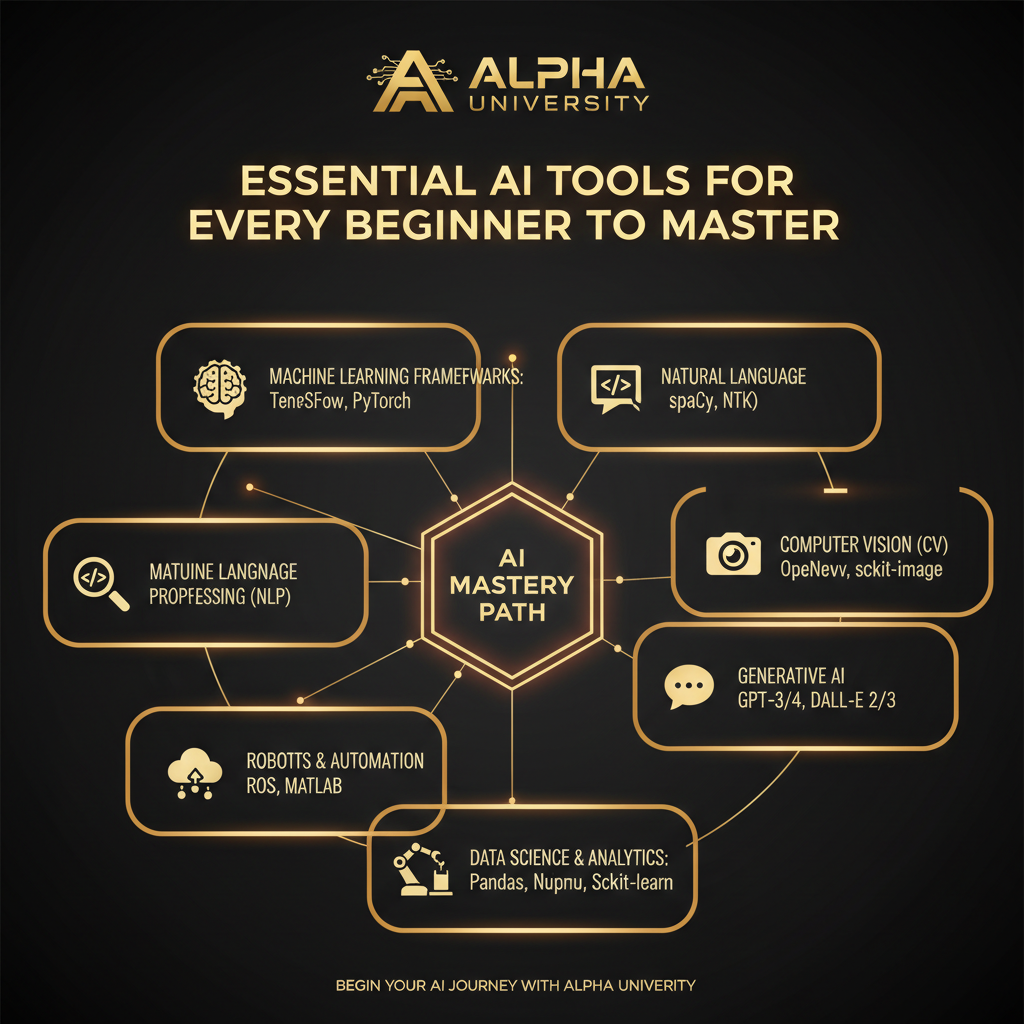
Understanding the AI Tool Landscape
A common mistake is thinking all AI tools are the same. In reality, they are specialized. Experts stress that "every AI tool excels at one thing" [source]. Understanding these categories is the first step to choosing the right tool for the job.
For beginners, the most important categories are:
* **Large Language Models (LLMs)**: These are the conversational AIs like ChatGPT and Gemini. They are your all-purpose assistants for drafting text, brainstorming ideas, summarizing documents, and even writing code. * **Creative and Productivity Tools**: This group includes AI-powered platforms for specific tasks like creating presentations (Canva), analyzing documents (NotebookLM), or generating images and video (Avido.ai). * **Analytical Tools**: These tools, like Hex, are geared towards data analysis and business intelligence, helping users find patterns and insights in complex datasets [source].
For a beginner, the journey starts with LLMs. They are the gateway to understanding how to communicate with and leverage AI.
Essential Large Language Models (LLMs) for Beginners
Community discussions and expert opinions consistently point to a core group of LLMs as the "obvious" starting point for anyone new to AI [source]. Mastering these will give you 80% of the capability you need for most general tasks.
ChatGPT: The All-Rounder
ChatGPT is the most recognized name in AI, and for good reason. It's a popular choice for everything from writing assistance to a brainstorming partner [source].
* **Key Strength**: Following complex, multi-step instructions without losing track of the context [source]. * **Best For**: Drafting emails, writing articles, debugging code, summarizing notes, and learning new topics. * **Beginner Tip**: Start by giving it a personality. Use prompts like, "Act as a marketing expert and help me brainstorm three taglines for a new coffee brand."
Google Gemini: The Multimedia Maestro
Google Gemini stands out for its native ability to understand and process more than just text. It's built to be a truly multimodal assistant.
* **Key Strength**: Handling and analyzing various media types, including video, audio, and large, complex files [source]. * **Best For**: Summarizing a YouTube video without a transcript, asking questions about the contents of a PDF, or creating plans based on multiple documents. * **Beginner Tip**: Use the feature that allows you to upload a screenshot or a document and ask questions about it. For example, upload a chart and ask, "What is the key trend in this data?"
Claude: The Polished Professional
Claude has gained a loyal following, particularly among professionals and developers, for the quality and safety of its output.
* **Key Strength**: Generating well-structured, working code and producing polished, professional-grade copy with an efficient workflow [source]. * **Best For**: Writing clean code, drafting corporate communications, and refining existing documents. * **Beginner Tip**: Use Claude to improve your own writing. Paste in a paragraph you've written and ask, "Can you make this more concise and professional?"
Perplexity AI: The Researcher
While other LLMs can "hallucinate" or invent facts, Perplexity is designed for accuracy, making it an indispensable tool for research.
* **Key Strength**: Fetching accurate, up-to-date information and providing direct citations for its sources [source]. * **Best For**: Answering factual questions, conducting market research, and finding credible sources for a project. * **Beginner Tip**: Use its "Focus" feature to narrow your search to academic papers, YouTube, or Reddit to get more specific results.
Foundational Creative and Productivity Tools
Once you're comfortable with a primary LLM, you can expand your toolkit with platforms designed for specific, high-value tasks.
* **Canva**: While known as a design platform, Canva's suite of AI-powered tools ("Magic Studio") is perfect for beginners creating visuals, presentations, and social media content [source]. * **NotebookLM**: A groundbreaking tool from Google that acts as a closed-source researcher. You provide the documents, and it will *only* answer questions based on the information you've given it, completely eliminating hallucinations [source]. * **Exploring Further**: For those with specific interests, tools like **Avido.ai** for AI video creation or **Hex** for data notebooks offer a glimpse into more advanced applications [source].
How to Choose Your First AI Tool
The best way to learn is by doing. Don't try to learn all these tools at once. Instead, pick one and integrate it into your daily workflow.
1. **Start with ChatGPT**: Its versatility makes it the ideal first tool to master. 2. **Identify a Pain Point**: What daily task is repetitive or time-consuming? Do you struggle to write emails? Do you need to summarize long reports? 3. **Apply the Tool**: Use your chosen AI tool exclusively for that task for one week. 4. **Evaluate and Expand**: After a week, assess how it helped. Then, either go deeper with more advanced features or pick a second tool from this list that complements the first.
Remember, proficiency in AI is not about a long list of [AI Tools](/ai-tools); it's about deeply understanding the capabilities of a few core ones.
Your AI Learning Roadmap at Alpha University
Self-teaching is possible, but a structured path accelerates your growth and ensures you're learning the right skills in the right order. This is where a dedicated program becomes invaluable. Courses focused on applied AI, like those at [AI University](/ai-university), are designed to move you from beginner to proficient user with a clear, guided curriculum.
Joining a program helps you build a foundational understanding that separates casual users from the professionals who will lead the [Alpha Generation](/alpha-generation). It provides a space to not just learn the tools, but to master the strategies behind them.
Ultimately, learning AI is a journey of continuous discovery. By starting with these essential tools, you are building a powerful skill set that will unlock new levels of creativity and productivity in any field. The future is being built with these platforms, and mastering them is the first step toward becoming a creator in the new age of intelligence.
*** ''', faqs=[BuildGeoArticleFaqs(question=